
If you've been thinking about installing an EV charger at your Connecticut home, the clock is ticking. The federal Section 30C tax credit—which covers 30% of your installation costs—expires on June 30, 2026. After that date, the credit disappears unless Congress extends it. And as of April 2026, no extension has been announced.
That means you have roughly 12 weeks to get a charger installed and claim up to $1,000 back on your taxes. Here's exactly what the credit covers, whether you qualify, and how to make sure you don't miss the deadline.
What Is the 30C Tax Credit?
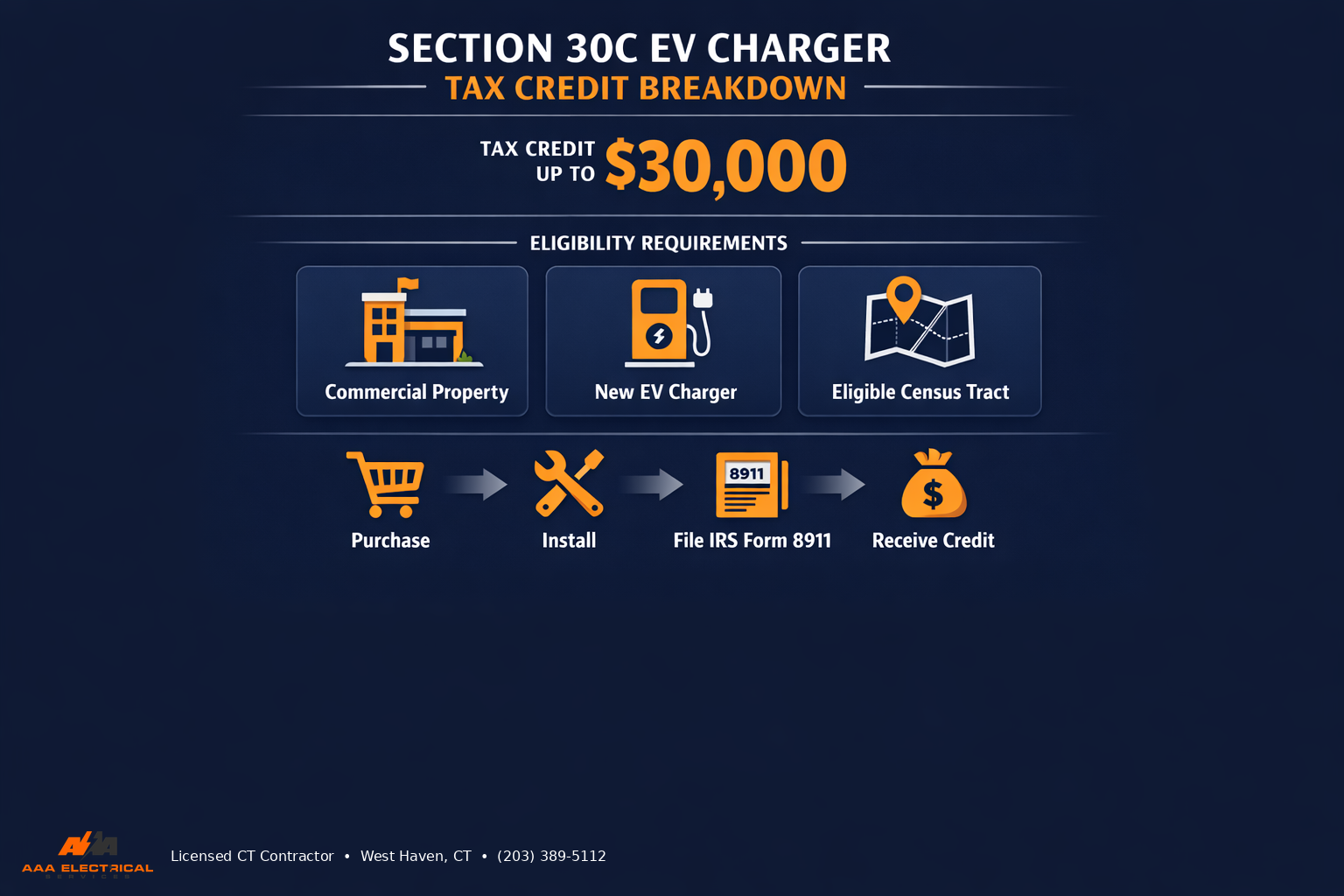
The 30C credit gives you 30% back on what you spend to install an EV charger. For homeowners, that's up to $1,000. It's non-refundable—meaning it reduces your tax bill dollar-for-dollar up to what you owe.
For businesses, the credit is way bigger—30% up to $100,000 per charger port. If you own commercial property, check our CT EV incentives guide for that side.
You claim it on IRS Form 8911 when you file your federal return. That's it.
How Much Will You Actually Save?
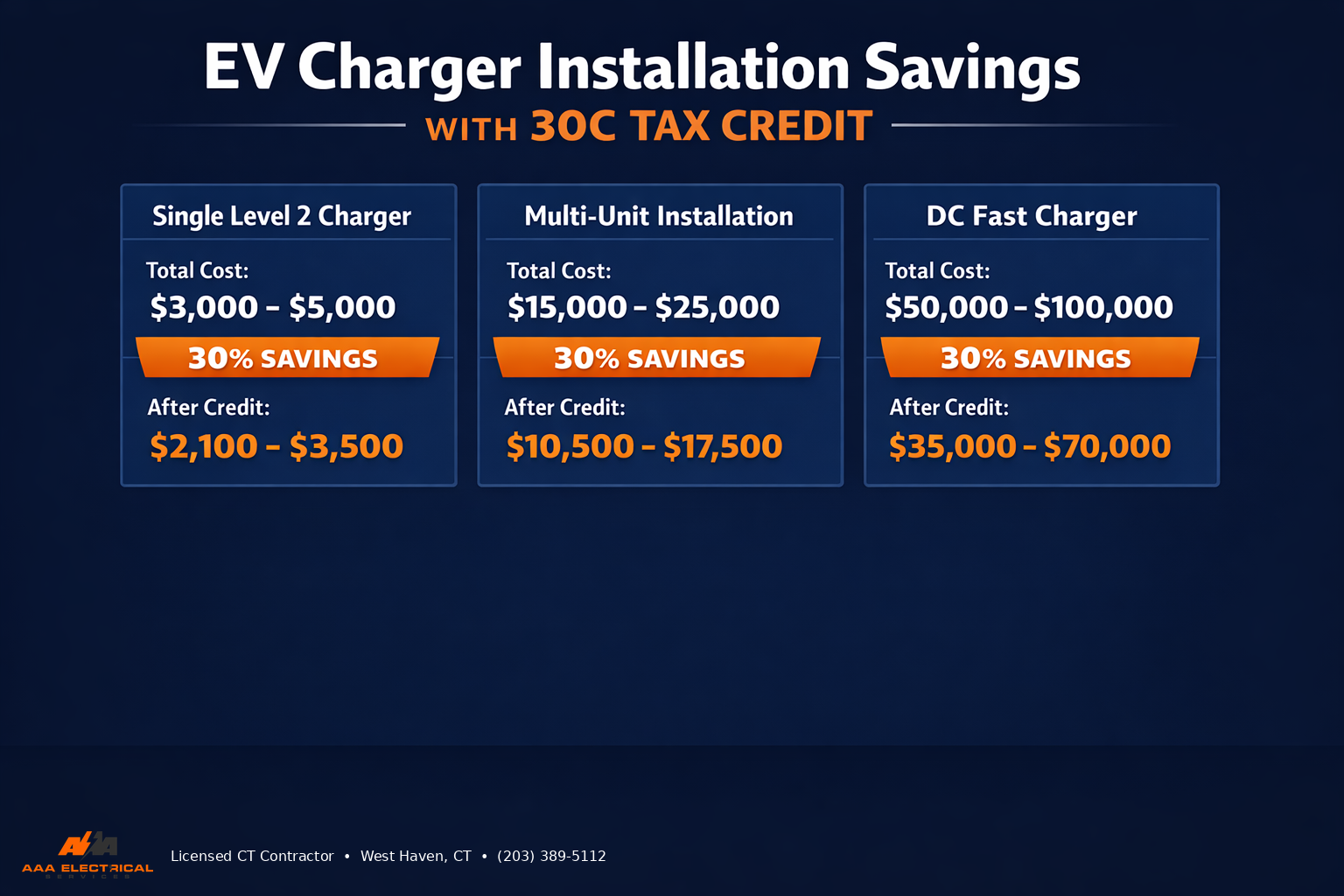
A typical Level 2 home EV charger installation in Connecticut costs between $1,500 and $3,000, depending on your electrical setup and how far the charger is from your panel. Here's what the math looks like:
Example 1 — Simple installation: Your panel is in the garage, close to where you park. Total cost: $1,800 (charger + installation). Your 30C credit: 30% × $1,800 = $540.
Example 2 — Panel is farther away: The electrician needs to run a longer circuit from the basement to a detached garage. Total cost: $3,200. Your 30C credit: 30% × $3,200 = $960, but the residential cap is $1,000, so you get $960.
Example 3 — Premium setup with panel work: You need a sub-panel in the garage plus the charger. Total cost: $4,500. Your 30C credit: 30% × $4,500 = $1,350, capped at $1,000.
No matter the scenario, the credit takes a real bite out of your cost. And when you stack it with CT utility rebates, it adds up fast.
Do You Qualify? The Census Tract Requirement
Here's where people get tripped up. To claim the residential 30C credit, your property has to be in an eligible census tract—either a low-income community or a non-urban area as the IRS defines it.
Good news: most towns in New Haven and Fairfield Counties qualify. The eligibility maps are generous, and a lot of suburban and semi-rural areas in southern CT fall inside the lines.
How to check if you qualify:
- Visit the IRS 30C credit page and use their census tract lookup tool
- Enter your home address to see if your tract is eligible
- Or call us at 203-389-5112—we'll check it for you in about 30 seconds
If your property is in an eligible zone, you're good. If it's not, the credit unfortunately doesn't apply to your location. But Eversource and UI rebates may still be available regardless of census tract.
Not Sure If You Qualify? We'll Check for Free
Call us and we'll verify your census tract eligibility, estimate your installation cost, and calculate your total savings with all available credits and rebates.
Call 203-389-5112How to Claim the 30C Credit
It's not complicated, but you need your paperwork in order:
1. Get a licensed electrician to install it. The work has to meet local code and be permitted. No permit, no credit. We pull the permit for you on every job.
2. Keep every receipt. Charger purchase receipt, electrician's invoice, building permit, inspection sign-off. Keep the originals.
3. File IRS Form 8911 with your tax return. Your accountant or tax software walks you through it—you enter total costs, and the form calculates 30% up to the $1,000 cap.
Important: The charger has to be installed and operational before June 30, 2026. Getting a quote doesn't count—the physical installation needs to be done.
Stacking the 30C Credit with CT Utility Rebates
The 30C credit isn't the only money on the table. Connecticut utilities have their own rebates you can stack on top:
Eversource: Residential EV charger rebates are income-restricted as of 2026 (household income at or below 300% of Federal Poverty Level, or in a designated High Poverty/Low Opportunity area). If you qualify, rebates cover a good chunk of charger hardware. Check energize.ct.gov or call Eversource at 203-350-3555.
United Illuminating: UI offers EV charging rebates that vary by project. Contact UI for current availability in your area.
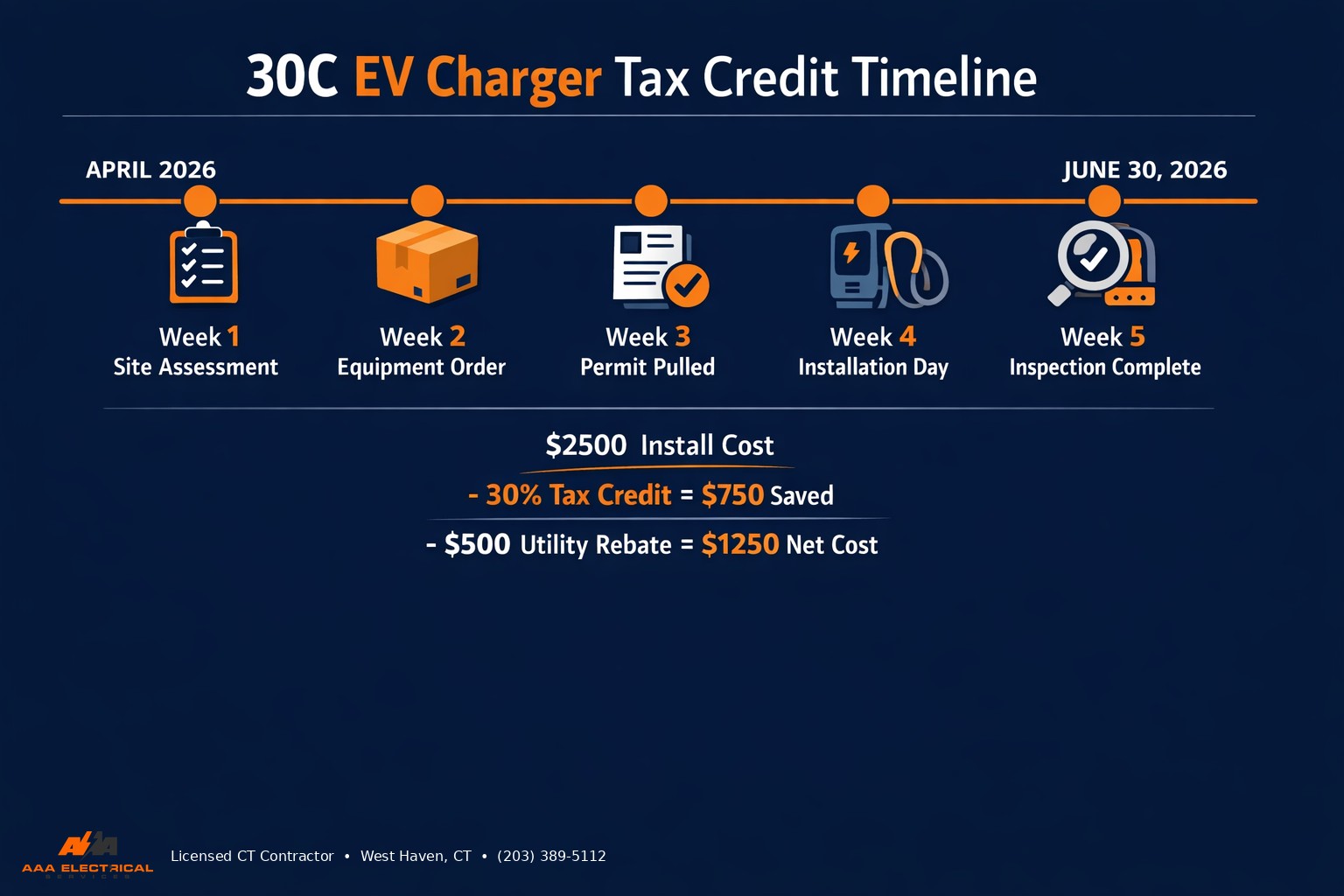
Stacking example: Total install cost of $2,500. You claim $750 from 30C (30%). Eversource rebate of $500 on hardware. Net cost: $1,250. That's half off.
We handle all the rebate paperwork on every install. No extra charge.
The Timeline: Can You Still Make the June 30 Deadline?
Yes—but you need to move now. Here's a realistic timeline for getting a home EV charger installed in Connecticut:
- Week 1: Site assessment and quote. We evaluate your panel, determine the best charger location, and provide a detailed estimate with credit/rebate calculations.
- Week 1–2: You approve the quote and we order equipment. Most Level 2 chargers are in stock or ship within a few days.
- Week 2–3: We pull the municipal electrical permit. Most CT towns issue permits within 5–10 business days.
- Week 3–4: Installation day. A typical home charger install takes 4–6 hours. We run the dedicated 240V circuit, mount the charger, and test everything.
- Week 4–5: Municipal inspection and sign-off. Your charger is officially "placed in service."
Total: 4–5 weeks from first call to operational charger. If you call us in early April, you'll be charging at home by mid-May—well within the June 30 deadline.
If you wait until late May or June, you're gambling. Permit delays, equipment backorders, or a packed schedule could push you past the deadline. Miss it by one day and you lose the entire credit.
After June 30, the credit goes to $0 unless Congress renews it—and copper prices and labor rates aren't going down. This is the best deal you're likely to see on an EV charger install.
Common Questions About the 30C Credit
Can I claim the credit for a Level 1 charger?
Technically yes—but you're better off going Level 2. Level 1 adds about 4 miles of range per hour. Level 2 adds 25–44. The cost difference is small, and the 30C credit applies to both.
Does the charger have to be new?
Yes. Used or refurbished chargers don't qualify.
What if I already have an EV charger and want to upgrade?
The new equipment and installation costs qualify. Just has to be placed in service before June 30, 2026.
12 Weeks Left — Don't Wait
We'll handle everything: site assessment, permitting, installation, inspection, and rebate paperwork. You just pick up the phone.
Call 203-389-5112Related Articles
Find Your Town
We install EV chargers across southern Connecticut and handle all incentive paperwork. Find your town: