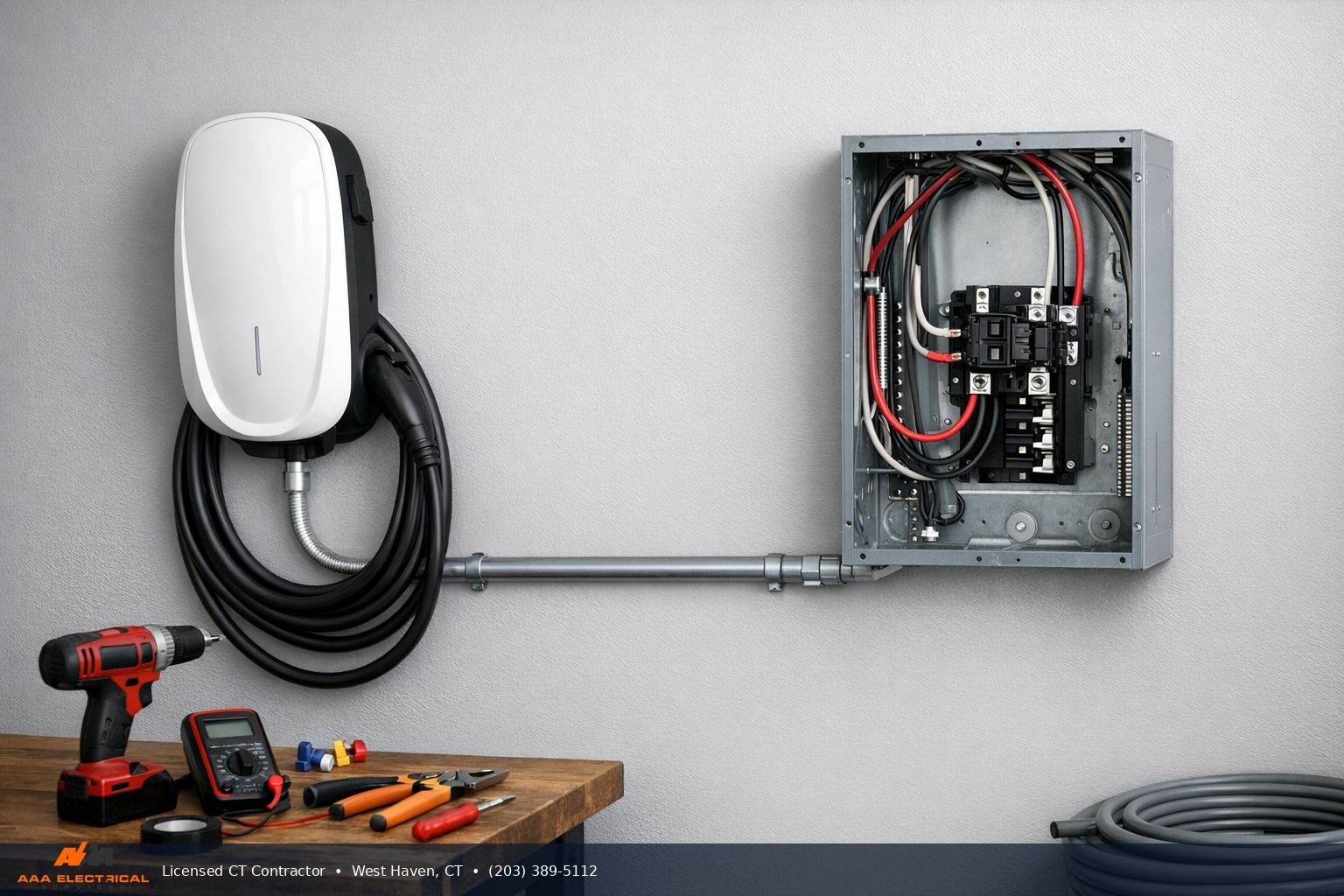
If you just bought an electric vehicle — or you're about to — one of the first questions you'll ask is: "How much does it cost to install a home charger?" The answer in Connecticut is: it depends.
Let's break it down so you know what you're actually paying for and what to expect when you call an electrician.
What Goes Into the Cost?
Three main things determine how much you'll pay for EV charger installation in Connecticut:
- The charger itself — Level 2 chargers range from $400–$1,200 depending on brand and features (smart charging, WiFi, load management).
- Electrical work — Running a new 240-volt circuit from your panel to the garage, installing a dedicated breaker, conduit, wiring, and the charger mount.
- Panel capacity — If your existing panel doesn't have room or capacity for a 40–60 amp circuit, you'll need a panel upgrade first.
Most straightforward installs in New Haven or Fairfield counties run $1,500–$2,500 total, including the charger, labor, permits, and materials.
When the Cost Goes Up
If your electrical panel is already maxed out, you're looking at a panel upgrade before the charger goes in. That adds $2,000–$4,000 to the project. But here's the thing: if your home was built before 1990, you probably need that upgrade anyway.
Distance matters too. If your panel is in the basement and your charger is going on the outside wall 80 feet away, you're paying for a longer wire run, more conduit, and more labor. Outdoor installs cost more than garage installs because of weatherproofing requirements.
What About Permits?
Every EV charger install in Connecticut requires an electrical permit. The permit itself is $40–$150 depending on your town. Any licensed electrician will pull that permit for you and schedule the inspection. If someone offers to skip the permit, walk away — that's code violation territory.
Connecticut Rebates Can Cut Your Cost
Here's the good news: Connecticut offers rebates that can bring your cost way down. Eversource and United Illuminating (UI) both offer up to $1,000 in rebates for residential EV charger installations.
Some towns and utilities also offer rebates for panel upgrades if you're installing clean energy equipment like an EV charger or solar. We help you apply for those — no extra charge.
There's also a federal tax credit of up to $1,000 for home EV charger installations (the Alternative Fuel Vehicle Refueling Property Credit). That's money back at tax time.
Level 1 vs. Level 2 — What's the Difference?
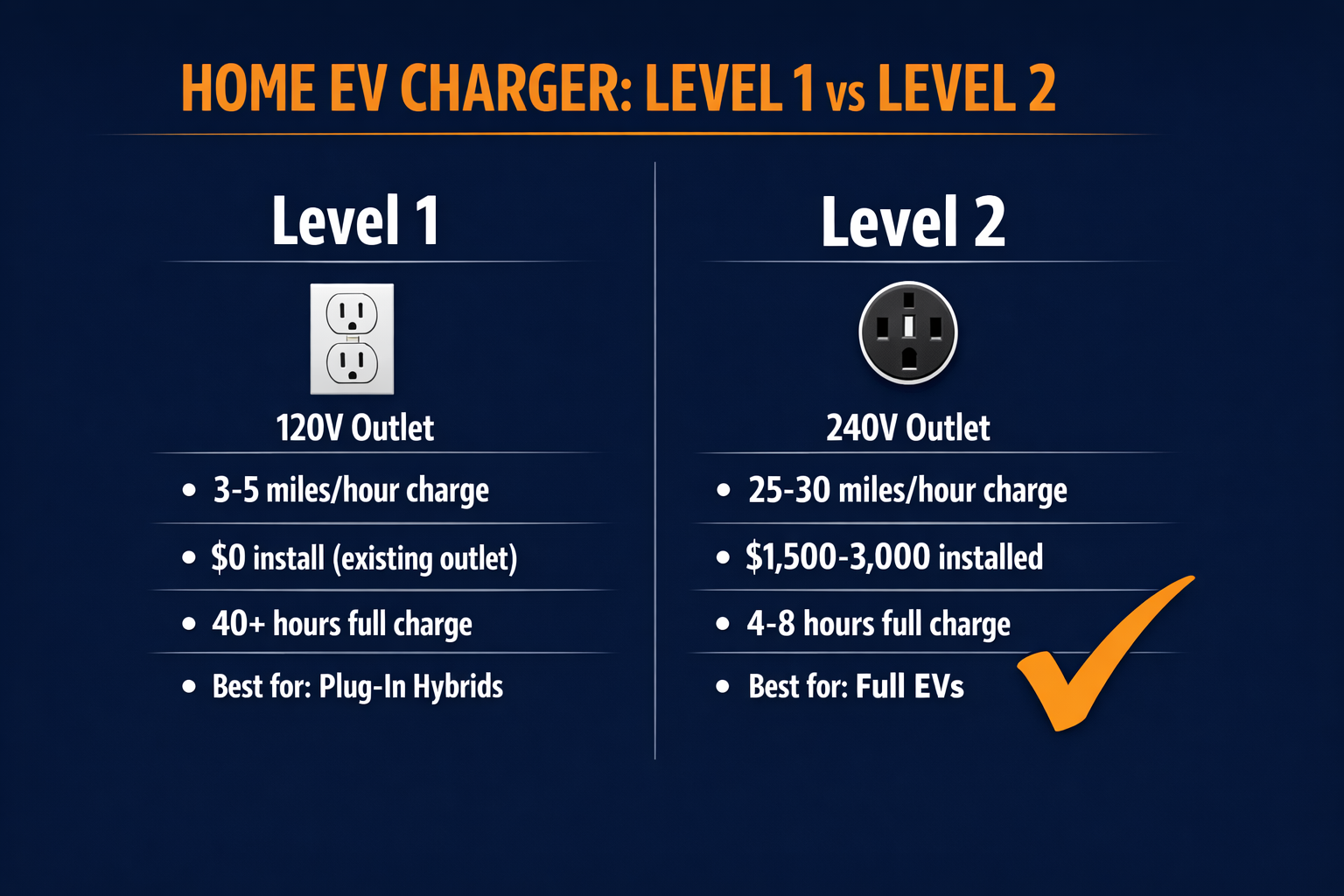
Your EV came with a Level 1 charger — the cord that plugs into a regular 120-volt outlet. It works, but it's slow. You're looking at 20+ hours for a full charge. Fine if you drive 30 miles a day and charge overnight. Not fine if you need to top up quickly.
Level 2 chargers run on 240 volts (same as your dryer). They charge 5–7 times faster. A full charge takes 4–8 hours instead of a full day. If you're serious about EV ownership, Level 2 is the way to go.
Level 3 (DC fast charging) is what you see at highway rest stops. It's industrial power — not something you install at home unless you're running a commercial fleet.
Which Charger Should You Buy?
We install all the major brands: Tesla Wall Connector, ChargePoint Home Flex, JuiceBox, Emporia, Grizzl-E. They all do the same basic job — the differences are in features.
Some have WiFi and smartphone apps so you can schedule charging during off-peak hours (cheaper electricity rates). Some have load management, which means they'll throttle back if your dryer kicks on. Some are just simple plug-and-charge units with no bells and whistles.
We'll recommend what fits your car, your electrical setup, and your budget. No upselling — just what works.
How Long Does Installation Take?
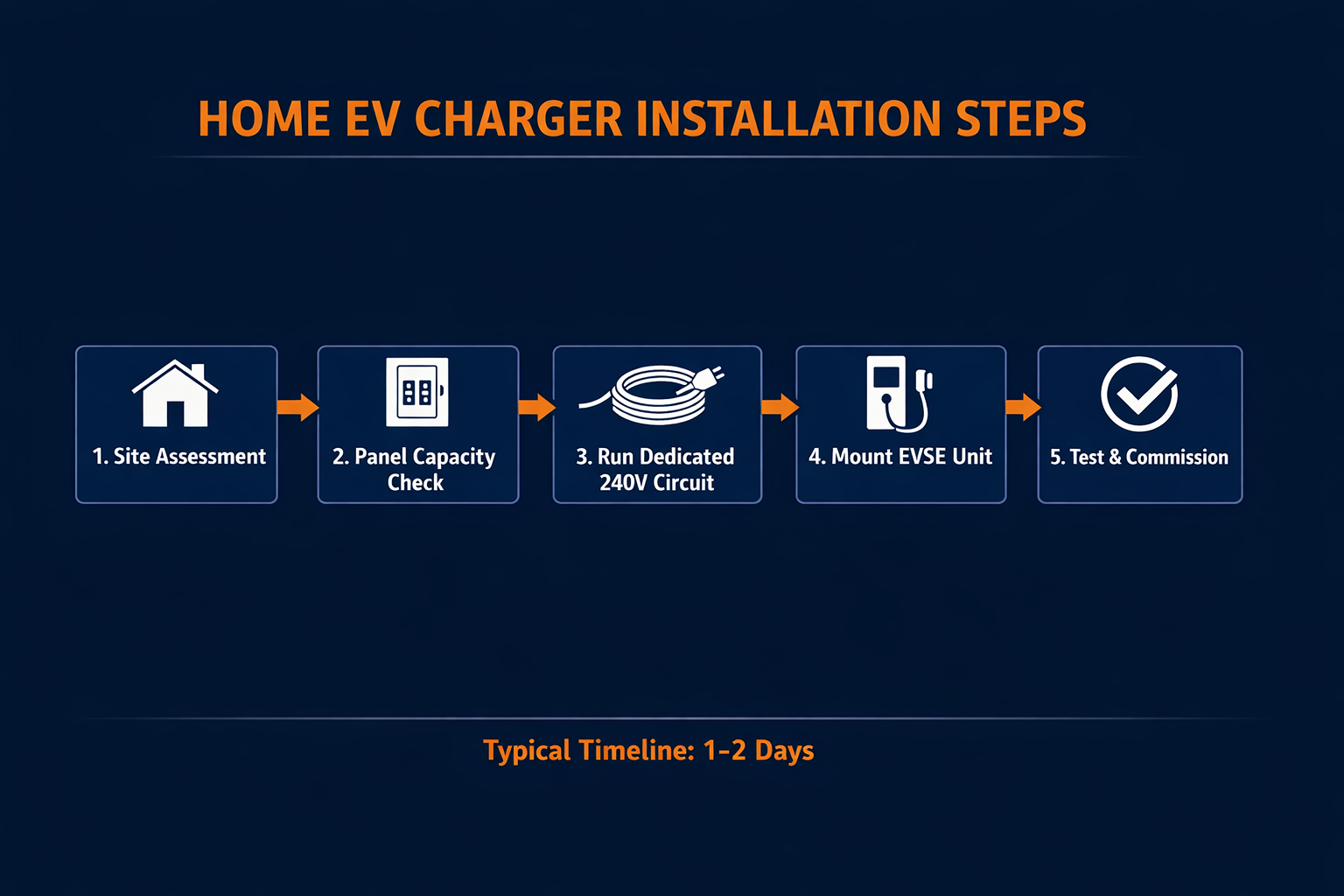
If your panel has capacity and the charger is going in the garage near the panel, we can usually knock it out in 4–6 hours. That includes running the circuit, mounting the charger, testing, and the town inspection.
If we're upgrading your panel first, add a day or two for the panel work, utility coordination, and inspection. We'll give you a timeline upfront so you know what to expect.
What About Condos and Apartments?
Connecticut law says condo associations and landlords can't prohibit you from installing an EV charger — but you're responsible for the cost and installation. That means hiring your own electrician, getting the HOA's approval on the install location, and handling permits.
It's doable, but it takes coordination. We've done plenty of condo installs in Milford, Shelton, and Hamden. We work with property managers to get approvals and schedule work that doesn't disrupt other residents.
Get a Free Estimate
Every home is different. Your panel, your service entrance, your garage layout — it all affects cost. The only way to get an accurate number is to have a licensed electrician come out and look.
We've been installing EV chargers across southern Connecticut since they became a thing. We're licensed (CT #E1-0191759), insured, and we handle the permits, the rebates, and the inspections. Call 203-389-5112 for a free estimate.
Need Help With This?
AAA Electrical Services has been doing this work across Southern CT for 17+ years.
Call 203-389-5112Related Services
Find Your Town
We provide EV charger installation services across southern Connecticut. Find your town for local service information: