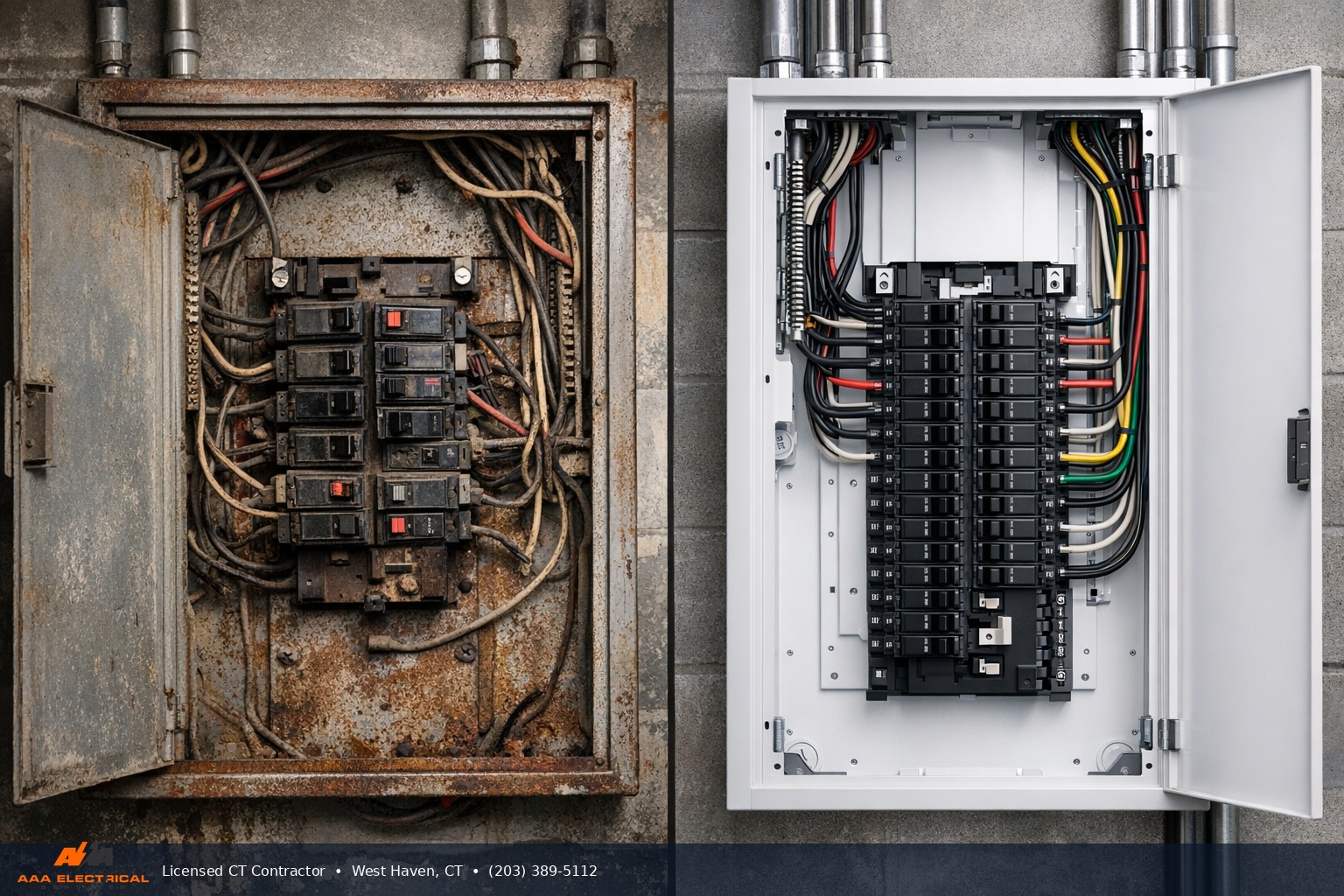
Your electrical panel is the heart of your home's power system. It's the metal box in your basement or garage that distributes electricity to every outlet, light, and appliance. Most Connecticut homeowners never think about it — until something goes wrong.
I've been doing electrical work across New Haven and Fairfield counties since 2009, and I can tell you this: a failing panel doesn't give you much warning. But there are signs. If you know what to look for, you can upgrade before you're stuck in the dark or dealing with a fire hazard.
Your Panel Is Older Than 25 Years
If your home was built before 2000, there's a decent chance your panel is undersized for modern life. Homes built in the '70s and '80s typically have 100-amp or even 60-amp service. That was fine when the biggest power draw was a window AC unit and a color TV.
Today? You've got computers, a 75-inch flatscreen, multiple phone chargers, a microwave, dishwasher, and maybe an EV charger in the driveway. That old 100-amp panel is maxed out.
Here in Connecticut, we see a lot of homes in Milford, Hamden, and Wallingford with original panels from the '60s and '70s. Some still have Federal Pacific or Zinsco breakers — both known fire hazards. If you've got one of those, don't wait. Get it replaced.
Breakers Trip All the Time
Circuit breakers are supposed to trip when a circuit overloads — that's their job. It's a safety feature. But if you're resetting breakers every week, or if running the microwave and toaster at the same time kills power to half the kitchen, that's a problem.
It means your circuits are overloaded or your panel can't handle the load. You're drawing more power than the system was designed for. An electrical panel upgrade to 200-amp service gives you the capacity to run everything at once without tripping breakers.
Lights Flicker When You Turn On Appliances
Does the kitchen light dim when the fridge kicks on? Do the lights flicker when you fire up the air conditioner? That's voltage drop — a sign that your panel is struggling to manage the load.
This is especially common in older New Haven County homes with aluminum wiring or undersized service. It's not just annoying — it's a fire risk. Loose connections and overloaded circuits generate heat, and heat leads to insulation breakdown.
You're Adding High-Power Equipment
If you're installing a Level 2 EV charger, a central air system, a hot tub, or a backup generator, your existing panel might not cut it. These systems pull serious amperage — typically 40-60 amps for an EV charger alone.
Before any of that gear gets installed, you need to make sure your panel has the capacity. Most often, that means upgrading to 200-amp service. We handle the permit, the utility coordination, and the installation. You just plug in when we're done.
Your Panel Feels Warm or Smells Like Burning Plastic
This one's urgent. If your panel is warm to the touch, if you hear buzzing or crackling sounds, or if you smell burning plastic near the breaker box, shut off the main breaker and call a licensed electrician immediately.
That's a sign of loose connections, corroded bus bars, or overloaded circuits. Any of those can start a fire. Don't ignore it. We respond same-day for emergencies like this.
You're Using Extension Cords Everywhere
If you've got power strips daisy-chained across the living room or extension cords running from room to room, your home doesn't have enough circuits. That's a capacity issue, and it's dangerous.
An electrical panel upgrade typically includes adding new circuits so you've got outlets where you actually need them — not a tangle of cords across the floor.
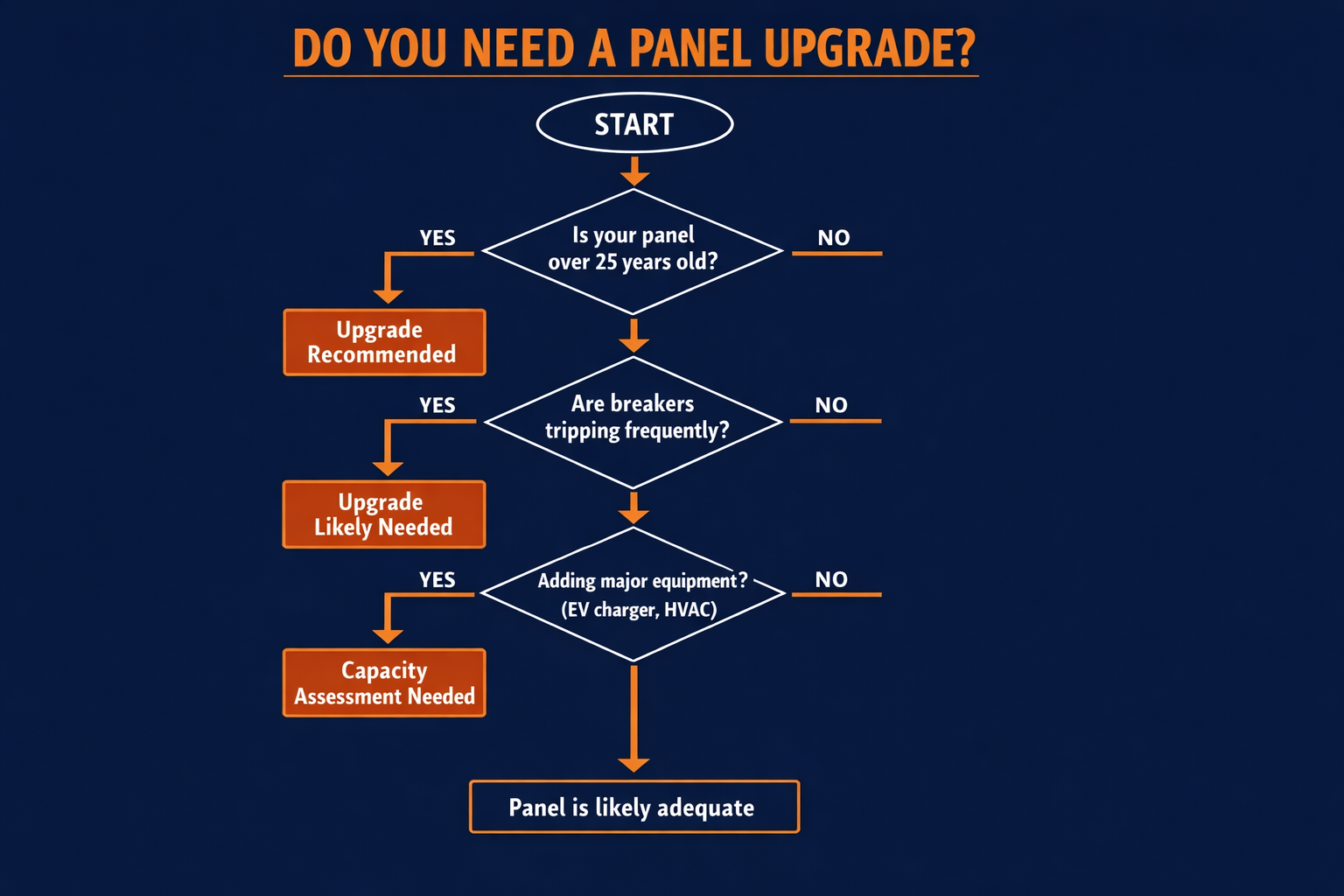
What to Expect During a Panel Upgrade
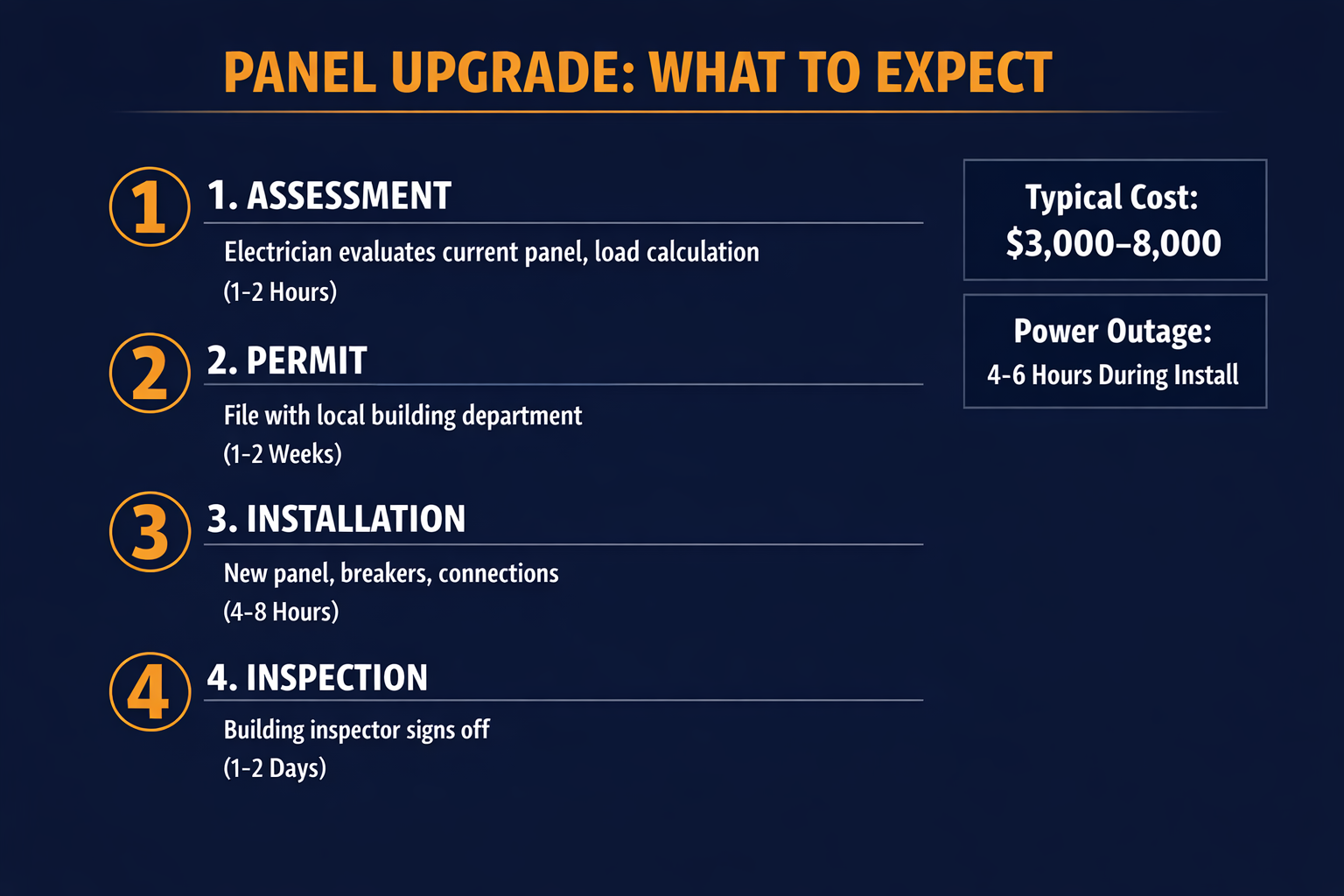
Here's how the process works in Connecticut:
- Inspection: We come out, look at your current panel, measure your load, and figure out what you need.
- Permit: We pull the permit from your local building department. Required for all panel work in CT.
- Utility coordination: If you need a service upgrade (from 100-amp to 200-amp), we coordinate with Eversource or UI to upgrade the meter and service drop.
- Installation: We install the new panel, rewire as needed, label everything clearly, and make sure it's code-compliant.
- Inspection: The town inspector signs off. You get a certificate of compliance.
Most upgrades take one to two days. Your power will be off for a few hours during the swap — we try to schedule that when it's least disruptive.
How Much Does a Panel Upgrade Cost in CT?
Panel upgrades in Connecticut typically run $2,000–$4,000 for a standard 200-amp upgrade, depending on your current setup and how much rewiring is needed. If your service entrance needs work or the utility has to upgrade the transformer, costs can go higher.
We give you a firm quote upfront — no surprises. And if you're upgrading to support an EV charger or solar installation, there may be rebates available through Eversource or UI. We'll help you find them.
Don't Wait Until You're in the Dark
Electrical panels don't last forever. If yours is showing any of the warning signs above, it's time to upgrade. Not next year — now. A failing panel isn't just inconvenient. It's a safety hazard.
We've been doing this work across southern Connecticut for 17 years. We're licensed (CT #E1-0191759), we're insured, and we stand behind every connection. Call AAA Electrical at 203-389-5112 for a free estimate.
Need Help With This?
AAA Electrical Services has been doing this work across Southern CT for 17+ years.
Call 203-389-5112Related Services
Find Your Town
We provide electrical panel upgrade services across southern Connecticut. Find your town for local service information: