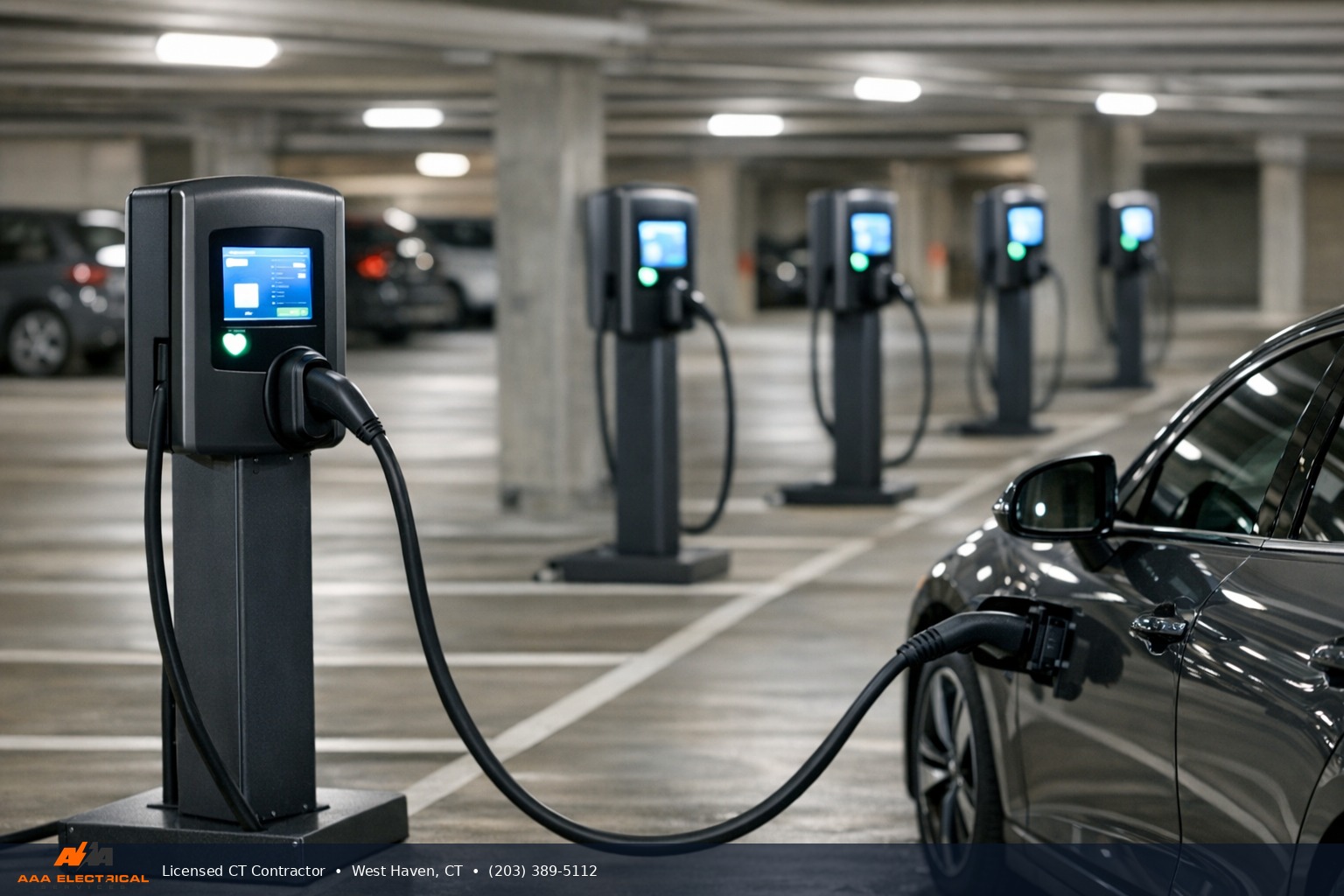
Commercial EV charging infrastructure isn't a luxury anymore—it's becoming a requirement for businesses that want to attract employees and customers. If you're running a facility in Connecticut and considering whether to add charging stations, the first question is obvious: how much does it cost?
The short answer: it depends. But we'll give you the long answer, the real numbers, and the incentives that can make it nearly free.
What's Actually Included in the Cost?
Commercial EV charger installation breaks down into four main expenses:
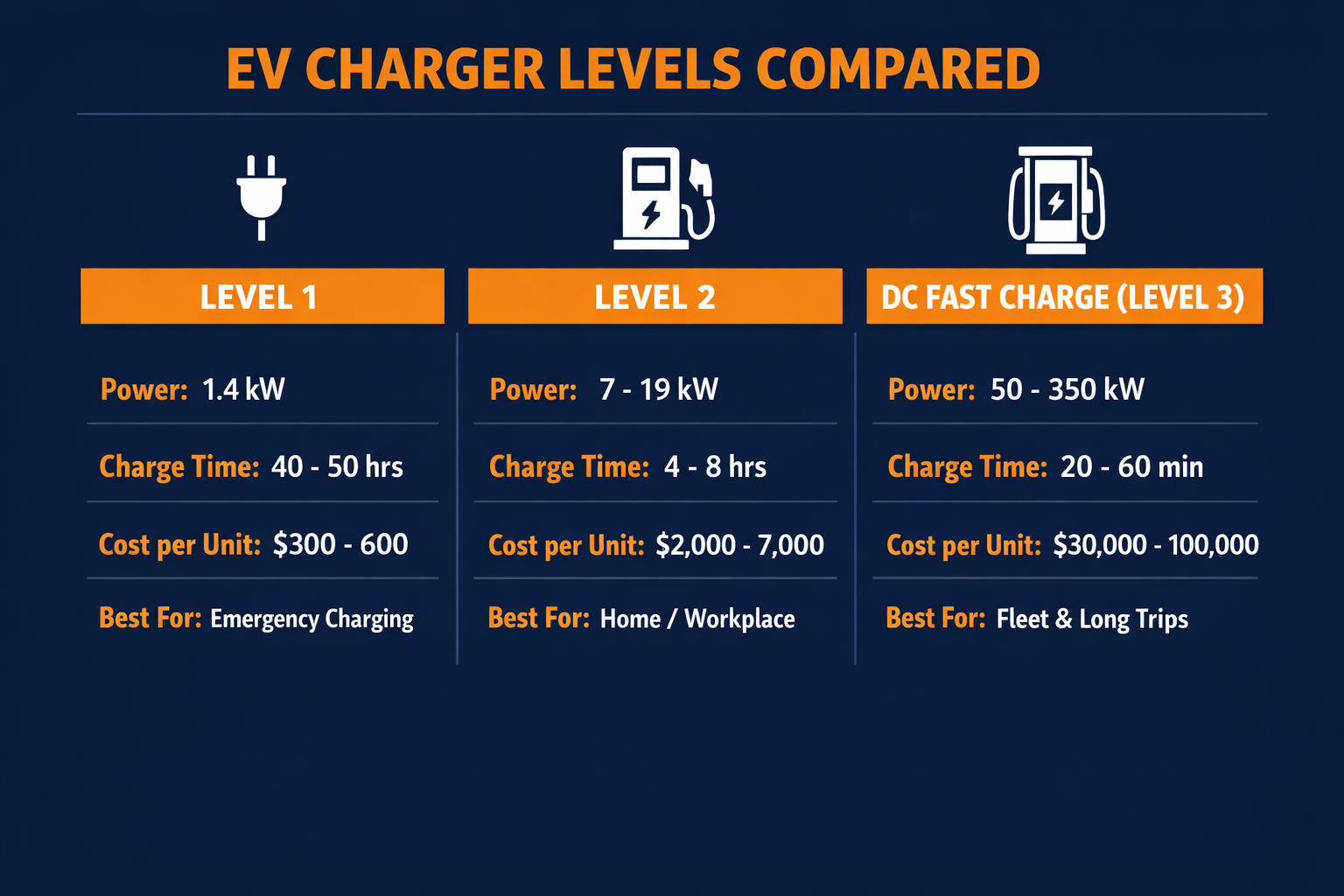
- The charger hardware — Level 2 chargers cost $800–$3,500 per unit. DC fast chargers run $30,000–$150,000 depending on power output and features.
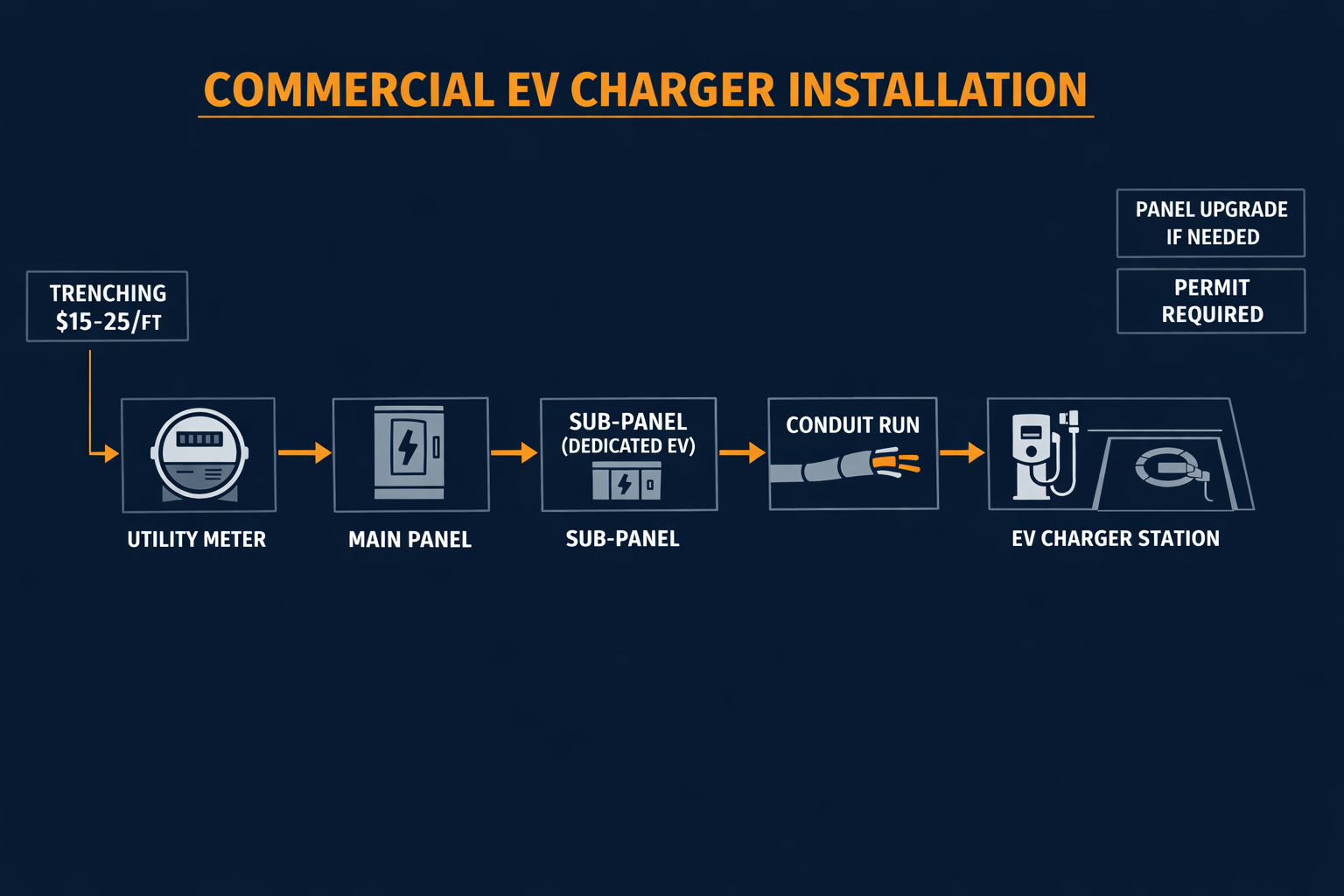
- Electrical infrastructure — Dedicated circuits, breakers, conduit, wiring, disconnect switches, and any panel upgrades needed.
- Site work — Concrete pads, trenching for underground conduit, pole mounting, weatherproofing, signage.
- Permitting and inspection — Municipal permits, interconnection approvals if you're tied to solar or battery storage, utility coordination.
For a typical multi-unit Level 2 installation (4–6 chargers) at a commercial site in Connecticut, expect $25,000–$60,000 total installed cost before incentives. For a single DC fast charger, you're looking at $60,000–$200,000 depending on site conditions.
Level 2 vs. DC Fast Charging: What You Actually Need
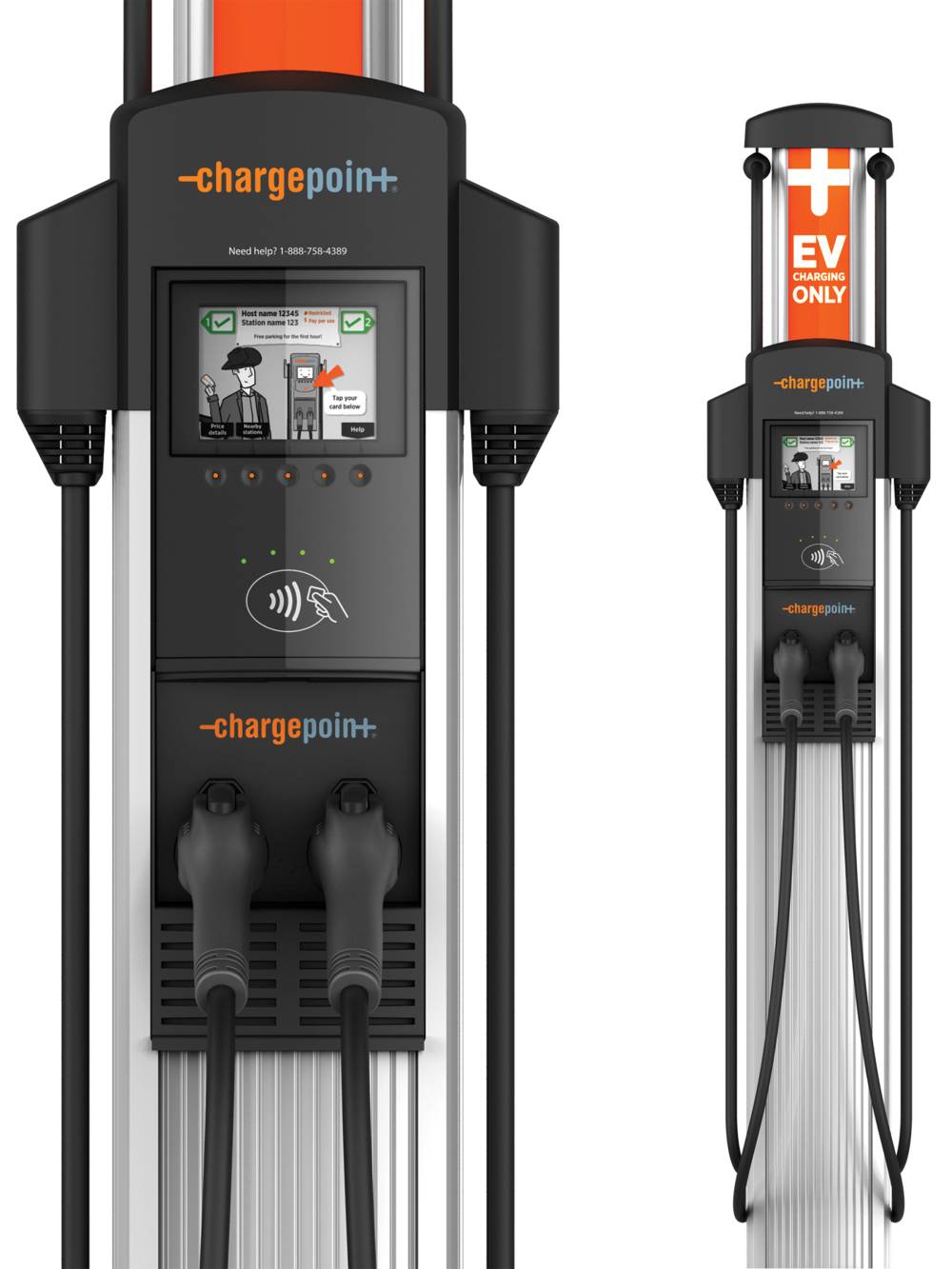
Level 2 chargers (240-volt, 7–19 kW) are the workhorse for commercial applications. They charge a vehicle 80% in 4–8 hours. Perfect for office parks, retail locations, and facilities where vehicles sit all day. Most businesses install Level 2 first.
DC fast charging (480-volt, 50–350 kW) is what you need for fleet operations, transit hubs, or if you want cars charged in 20–45 minutes. It's significantly more expensive and requires major electrical infrastructure. You'll need a dedicated transformer, upgraded service, and utility coordination.
A quick rule: if employees and customers are parked for hours, Level 2 is cost-effective. If turnover is fast and charging speed is critical, DC fast charging makes sense—but the ROI is longer.
Not Sure Which Type Your Business Needs?
Call us for a free assessment. We'll review your parking patterns, employee commute data, and customer behavior to recommend the right solution.
Call 203-389-5112Cost Breakdown: A Real Example
Let's say you're a mid-sized office building in New Haven with 40 parking spaces and you want to install 6 Level 2 chargers. Here's what the numbers look like:
- 6 × Level 2 chargers @ $1,500 each = $9,000
- Electrical work (circuits, breakers, conduit, wiring) = $12,000–$16,000
- Site work (concrete pads, signage, weatherproofing) = $4,000–$6,000
- Permitting and inspection = $800–$1,500
- Total = $25,800–$32,500
If your panel is maxed out and needs an upgrade, add $3,000–$8,000. If chargers are far from your panel, add $2,000–$5,000 for extended conduit runs.
Federal and Connecticut Incentives: The Game Changer
Here's where things get interesting. As of March 2026, the federal 30C tax credit is still active—but it expires June 30, 2026. That deadline matters.
Federal 30C Tax Credit (expires June 2026): Up to $100,000 per charger port for businesses. Yes, $100,000 per charger. If you install 6 chargers, you can claim up to $600,000 in tax credits. The requirements: equipment must be new, installed at a qualified location (not a residence), and you must be placed in service before June 30, 2026.
Eversource and UI Rebates: Both utilities offer rebates. Check energize.ct.gov for current programs. Eversource typically covers 50% of hardware costs (capped at $5,000 per charger). United Illuminating covers equipment and some installation labor.
Connecticut Incentive Stacking: This is the secret. You can often stack incentives. Federal 30C covers labor and installation. Eversource covers hardware. Some municipalities add grants on top. We've seen projects where the business paid nearly zero out of pocket.
Example stacking: 6 chargers at $25,000 installed.
- Federal 30C on labor/installation (expires June 2026): ~$15,000
- Eversource hardware rebate: $30,000 (capped at $5,000/charger)
- Municipal grant (some towns): $3,000–$5,000
- Net cost to you: $0–$5,000
But—and this is critical—the federal credit expires June 30, 2026. If you want to capture that funding, you need to start the permitting process now.
Installation Process: Timeline and What to Expect
Week 1–2: Assessment and Planning — We inspect your panel, evaluate site conditions, run load calculations, and determine if an upgrade is needed. We pull initial sketches and quotes for permits.
Week 2–4: Permitting — We handle municipal permits and utility interconnection applications. Connecticut municipalities are typically fast—most issue permits in 2–3 weeks. Utility interconnection can take 4–6 weeks depending on complexity.
Week 4–6: Incentive Applications — While permitting happens, we help you apply for 30C tax credits, Eversource rebates, and municipal grants. We prepare documentation, handle submissions, and track approvals.
Week 6–8: Electrical Work — If a panel upgrade is needed, we do that first. Then we run circuits, install conduit, mount chargers, and coordinate utility work. This typically takes 2–4 weeks for 6 chargers depending on site complexity.
Week 8–10: Inspection and Testing — Municipal inspection, utility interconnection testing, and final commissioning. Once we get the green light, chargers are live.
Total timeline: 8–12 weeks from start to operational.
Why Your Panel Might Need an Upgrade
Commercial buildings often have maxed-out electrical panels. A Level 2 charger draws 30–80 amps per unit. Six chargers can draw 300+ amps. If your panel is already running at 80–90% capacity, you'll need an upgrade before chargers go in.
Panel upgrades cost $4,000–$12,000 depending on whether we're upgrading the main breaker, service entrance, or transformer. It's an upfront cost, but it also improves your facility's electrical capacity for future equipment and operational needs.
We run a free load calculation to tell you if an upgrade is needed. No surprises—just honesty.
ROI: When Does It Make Financial Sense?
For most commercial facilities, the ROI breaks down like this:
- Recruitment and retention: Companies with workplace charging see 15–20% better hiring outcomes. Employees value it. Calculate the cost of losing one key employee—usually way more than the charging installation.
- Customer attraction: Retail and hospitality get longer dwell times. EV owners spend more when they have time to charge. Hotels see higher booking rates with charging available.
- Tax credits and rebates: Federal 30C (expires June 2026) alone can cover 30–50% of costs. Stack Eversource rebates and municipal grants, and you're often covering 60–80% before the building sees any revenue benefit.
- Operating costs: Electricity is cheaper than gasoline. If you're charging fleet vehicles, fuel savings can be 50–70% annually compared to gas equivalents.
Payback typically happens in 3–7 years for office and retail, 1–3 years for fleet operations. And once you've paid for the infrastructure, you're making money on it for 15+ years.
The June 2026 Deadline: Why It Matters Now
The federal 30C tax credit is scheduled to expire June 30, 2026. That means if you want to claim the credit, your project needs to be under contract or started before that date. Many businesses are pushing decisions forward right now to catch the deadline.
If you're on the fence, now is the time to get a quote and start permitting. The process takes 8–12 weeks. That puts you at the finish line just as the incentive window closes—and gives you time to capture that federal funding.
After June 30, the credits drop or disappear entirely. That makes every project significantly more expensive.
What AAA Handles (So You Don't Have To)
We've been installing commercial EV charging systems across Connecticut since 2009. Our team (CT License #E1-0191759) handles everything: electrical design, permits, utility coordination, incentive applications, installation, and final inspections.
We know the municipal processes in every town from New Haven to Westport. We know which utilities are fast and which require follow-ups. We know how to stack incentives to maximize your savings. You manage your business—we manage the electrical complexity.
Ready to Add Commercial EV Charging?
We've been installing commercial charging systems across Southern Connecticut for 17+ years. Let's talk about your facility's needs and get you in front of the June 2026 deadline.
Call 203-389-5112Related Services
Learn More About EV Incentives
Want a deeper dive into how to stack federal, utility, and municipal incentives? Check out our complete incentive guide:
Find Your Town
We install commercial EV charging stations across southern Connecticut. Find your town for local service information: