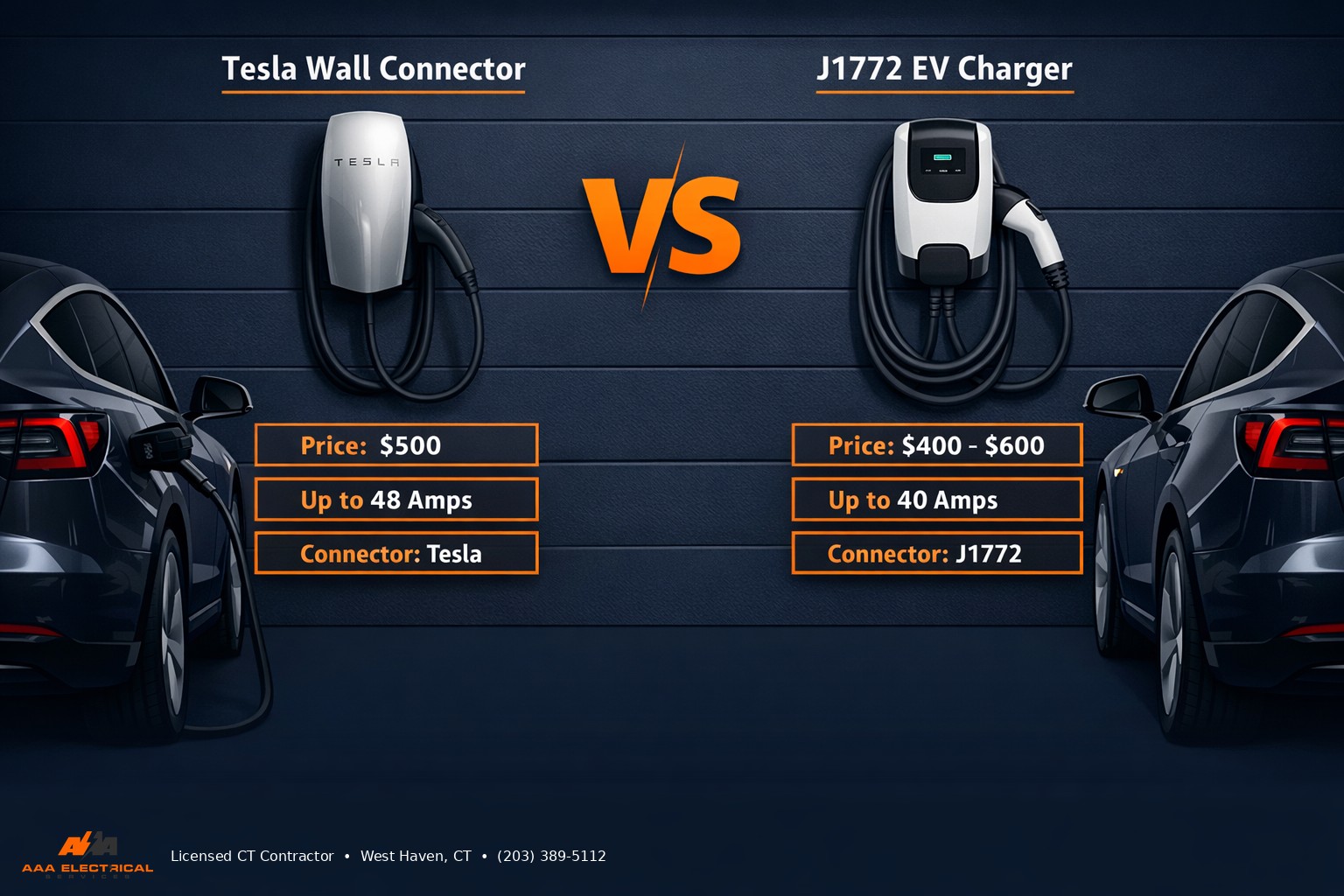
You've decided to install a Level 2 EV charger at home. Now comes the question every EV owner in Connecticut faces: do you buy the Tesla Wall Connector, or go with a universal charger that works with any electric vehicle?
It's not as simple as "buy Tesla if you drive a Tesla." The connector game has changed, and the answer depends on what you drive now, what you might drive next, and how much you want to spend. We install both types every week across New Haven and Fairfield Counties—here's the honest breakdown.
The Quick Answer
If you have a Tesla and will only ever charge Teslas at home, the Tesla Wall Connector ($450) is the best value. If you have a non-Tesla EV, or if there's any chance you'll own a non-Tesla in the future, get the Tesla Universal Wall Connector ($620) or a third-party universal charger like the ChargePoint Home Flex ($500–$600) or Grizzl-E ($400–$500).
Now let's get into why.
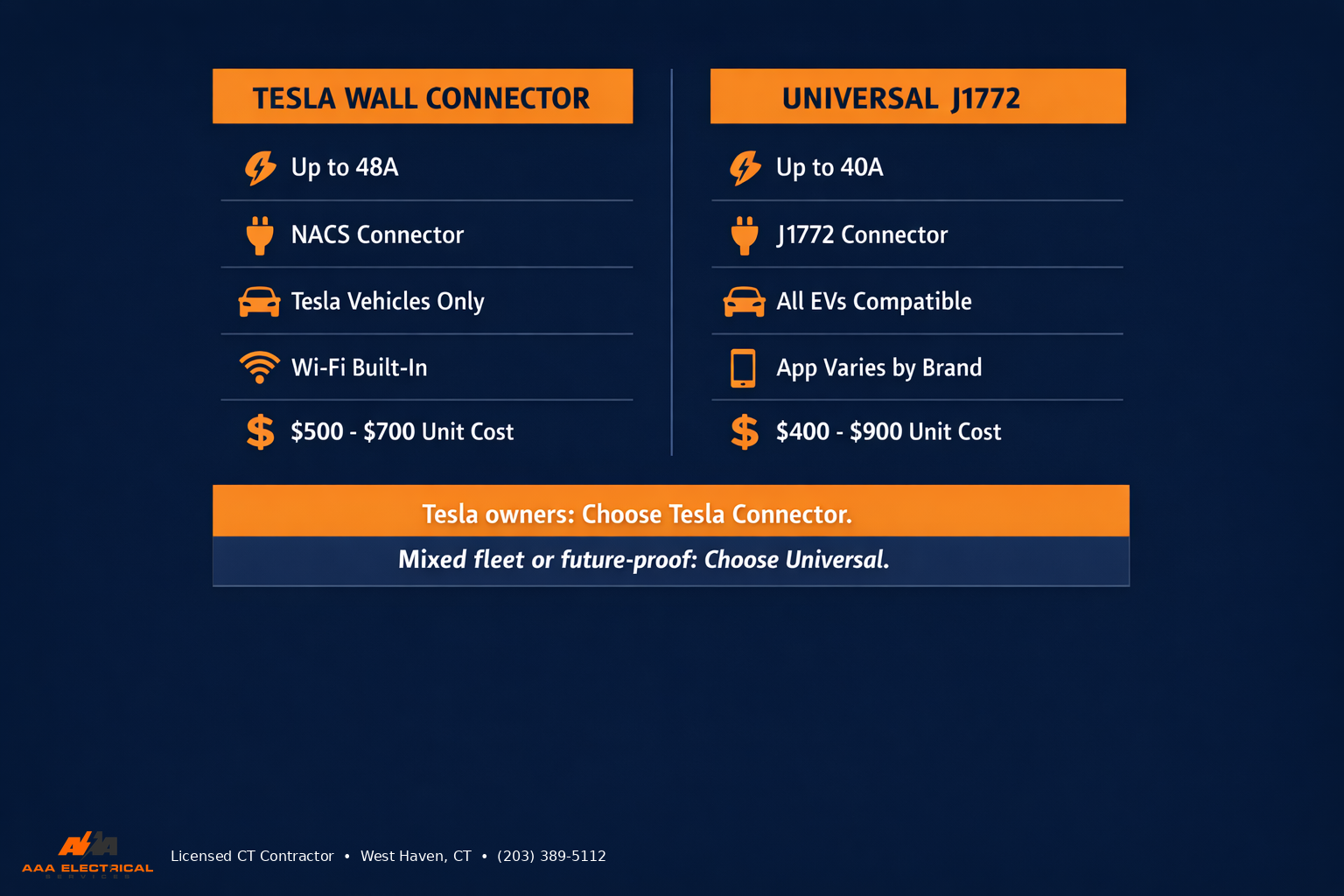
Head-to-Head Comparison
| Feature | Tesla Wall Connector | Tesla Universal Wall Connector | ChargePoint Home Flex |
|---|---|---|---|
| Price (charger only) | $450 | $620 | $500–$600 |
| Max amperage | 48A | 48A | 50A |
| Charging speed | Up to 44 mi/hr | Up to 44 mi/hr | Up to 37 mi/hr |
| Connector type | NACS (Tesla only) | J1772 + NACS adapter | J1772 (universal) |
| Works with Tesla? | Yes | Yes (via adapter) | Yes (via adapter) |
| Works with non-Tesla? | No | Yes | Yes |
| WiFi / App control | Yes (Tesla app) | Yes (Tesla app) | Yes (ChargePoint app) |
| Power sharing | Up to 6 units | Up to 6 units | No |
| Circuit required | 60A / 240V | 60A / 240V | 50A or 60A / 240V |
| Cord length | 24 ft | 24 ft | 23 ft |
| Warranty | 4 years | 4 years | 3 years |
NACS vs J1772: The Connector Confusion
This trips people up, so let's clear it up fast.
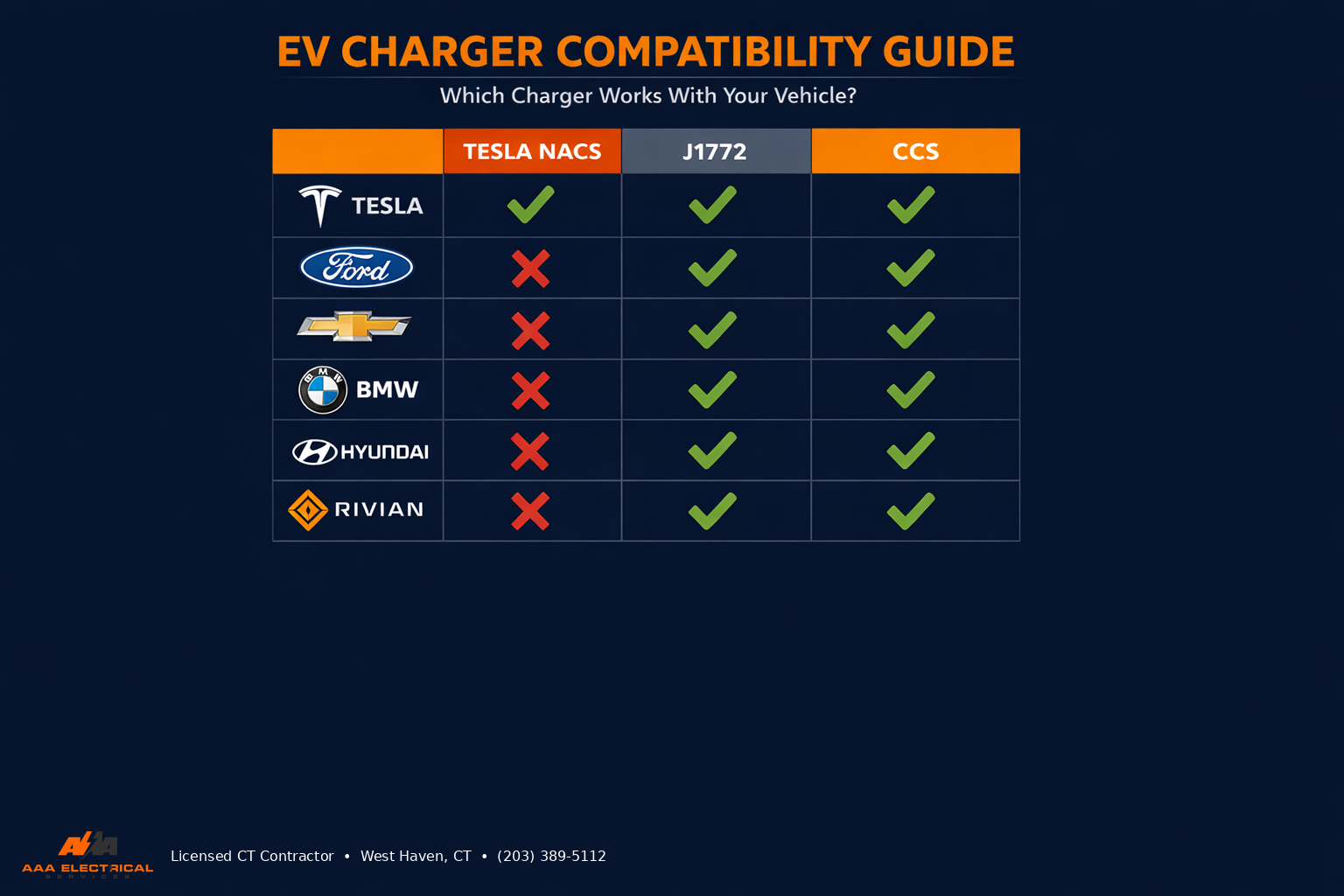
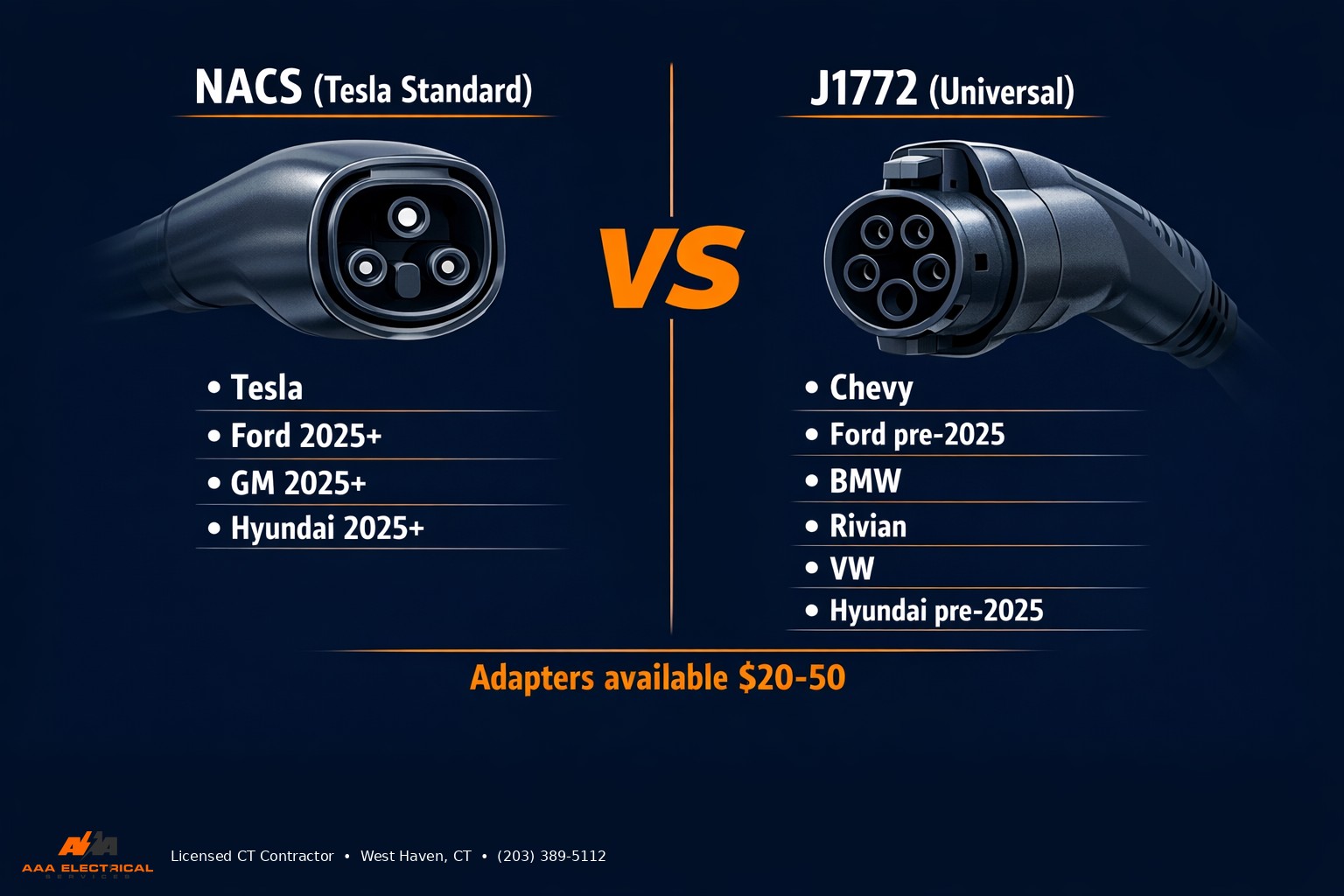
J1772 has been the standard EV plug in North America for over a decade. Every non-Tesla uses it—Chevy, Ford, Hyundai, BMW, Rivian. A "universal" charger comes with a J1772 plug.
NACS is Tesla's connector. Starting in 2025, most major automakers adopted NACS for new models too—so the industry is shifting toward it. Adapters exist for both directions and cost $20–$50.
Bottom line: NACS is becoming the standard. But if you have a J1772 vehicle now, or might get one as a second car, a universal charger covers you without adapters.
When to Choose the Tesla Wall Connector ($450)
The standard Tesla Wall Connector makes sense if all three of these are true:
- You own a Tesla and plan to keep driving Teslas
- Nobody else in your household will charge a non-Tesla EV at home
- You want the lowest upfront cost and the tightest integration with the Tesla app
At $450, it's the cheapest name-brand Level 2 charger with WiFi. It talks directly to your Tesla for optimized charging schedules, and the app gives you full control.
The catch: if your spouse buys a Chevy Equinox EV or you trade your Tesla for a Rivian, you'll need an adapter or a new charger.
When to Choose a Universal Charger
A universal charger is the better call if any of these apply:
- You own a non-Tesla EV (Chevy, Ford, Hyundai, BMW, etc.)
- Your household has multiple EVs or might in the future
- You want to future-proof your investment
- You plan to sell your home eventually (universal chargers appeal to more buyers)
Tesla Universal Wall Connector ($620): This is Tesla's own answer to the compatibility problem. It comes with a J1772 connector that works with every EV on the road, plus a NACS adapter for Teslas. You get the same Tesla build quality and app integration, just with broader compatibility. The $170 premium over the standard Wall Connector is worth it for most households.
ChargePoint Home Flex ($500–$600): ChargePoint is the most widely recognized name in public EV charging, and their home charger is rock-solid. Adjustable amperage (16A to 50A) means it works even if your panel can only spare a 40-amp circuit. The app is excellent. The downside: no NACS adapter included.
Grizzl-E ($400–$500): A no-frills workhorse made in Canada. No WiFi, no app—just plug in and charge. It's hardwired, rated for indoor/outdoor use, and built like a tank. If you don't care about smart features and want reliability at the lowest price, the Grizzl-E is hard to beat.
Not Sure Which Charger Is Right for You?
We'll assess your panel, recommend the best charger for your vehicle and budget, and install it. Same electrical work either way.
Call 203-389-5112The Electrical Installation Is the Same Either Way
Here's what most people don't realize: the charger brand doesn't change the installation work. Whether you mount a Tesla Wall Connector or a ChargePoint Home Flex, the electrical requirements are nearly identical:
- A dedicated 240V circuit from your electrical panel to the charger location
- A 40-amp or 60-amp breaker (depending on charger amperage)
- 6-gauge or 4-gauge copper wire (depending on circuit length and amperage)
- A weatherproof junction box if the charger is outdoors
- Municipal electrical permit and inspection
The installation labor cost is the same regardless of charger brand. In Connecticut, that typically runs $800–$1,500 depending on how far the charger is from your panel and whether any panel work is needed.
So your total cost is: charger price + installation labor. A Tesla Wall Connector installed runs about $1,250–$1,950. A ChargePoint Home Flex installed runs about $1,300–$2,100. The difference is the charger cost, not the electrical work.
What About Charging Speed?
Here's what people overthink: at home, charging speed barely matters. At 48 amps, both Tesla Wall Connectors add about 44 miles of range per hour. For most non-Tesla EVs, the car's onboard charger maxes out at 32 or 40 amps—so the car is the bottleneck, not the wall unit.
You plug in when you get home. You're fully charged by morning. Whether that takes 4 hours or 6 hours doesn't matter when you're sleeping. Every Level 2 charger handles overnight charging just fine.
Resale Value: What Home Buyers Want
If you might sell your home in the next 5–10 years, go universal. A buyer driving a Ford or Hyundai sees a Tesla-only charger as a hassle—they'll need an adapter or a replacement. A universal charger works for everyone.
Homes with EV chargers sell faster. But the charger needs to be universal for maximum appeal. Tesla-only means a smaller buyer pool.
Our Recommendation
After installing hundreds of EV chargers across southern Connecticut, here's what we tell most homeowners:
If you're a Tesla household and always will be: Get the standard Tesla Wall Connector. It's $450, integrates perfectly with the Tesla app, and delivers the fastest charging speeds for your car.
If you want flexibility (which most people should): Get the Tesla Universal Wall Connector for $620 or the ChargePoint Home Flex for $500–$600. The extra $50–$170 buys you compatibility with every EV on the market, better resale value, and peace of mind.
If you want the cheapest reliable option: The Grizzl-E at $400–$500 with J1772 is tough to beat. No smart features, but it charges your car reliably for years.
Whichever you choose, the electrical installation is the same. We handle the permit, the wiring, the mounting, and the inspection. You pick the charger that fits your situation.
Remember: The federal 30C tax credit covers 30% of your total installation cost (up to $1,000 for residential). It expires June 30, 2026. Read our full 30C credit guide to make sure you qualify before the deadline.
Ready to Install? We Handle Everything
Site assessment, charger recommendation, permitting, installation, inspection, and rebate paperwork. One call, done.
Call 203-389-5112Related Articles
Find Your Town
We install EV chargers across southern Connecticut. Find your town: