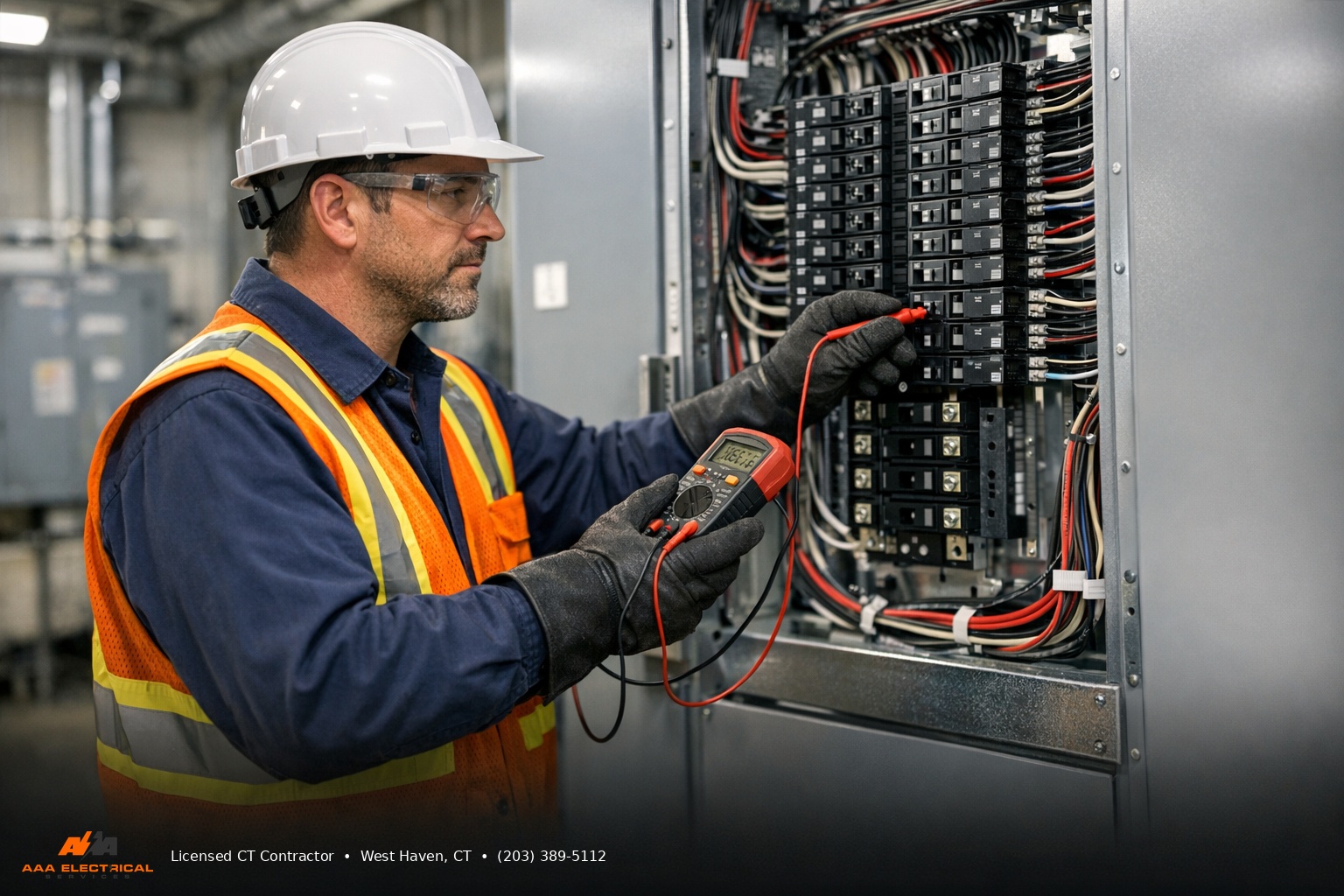
Spring's here, which means you're thinking about your parking lot, your HVAC system, and your roof. But your electrical system? That's getting skipped — and that's a mistake.
Winter does a number on electrical systems in Connecticut. Freezing temperatures, moisture, and freeze-thaw cycles create loose connections, corroded terminals, and failing components that quietly sit in your panel waiting to cause trouble. By the time you notice a problem in July, you're dealing with an emergency. We run a spring electrical maintenance checklist to catch those issues before summer heat loads stress your system further.
Why Spring Electrical Maintenance Matters for Commercial Buildings
Your commercial building transitions from winter heating to potential summer cooling this time of year. That shift means your electrical system moves from one load pattern to another. Problems hidden during low-load winter months show up immediately when you demand more from the system.
Winter weather in Connecticut causes specific electrical damage. Moisture gets into outdoor disconnects and panel enclosures. Freeze-thaw cycles loosen bolted connections. Cold temperatures stress equipment past their rated limits. By spring, your system's running on borrowed time.
A spring inspection finds these problems before summer demands expose them. You catch a failing breaker in April, not during a heatwave in August. You tighten loose connections now, not after they've caused equipment damage. That's what spring maintenance is about — prevention, not emergency response.
The 7-Point Spring Electrical Maintenance Checklist
We follow the same checklist every spring for every commercial building we service. Here's what gets tested.
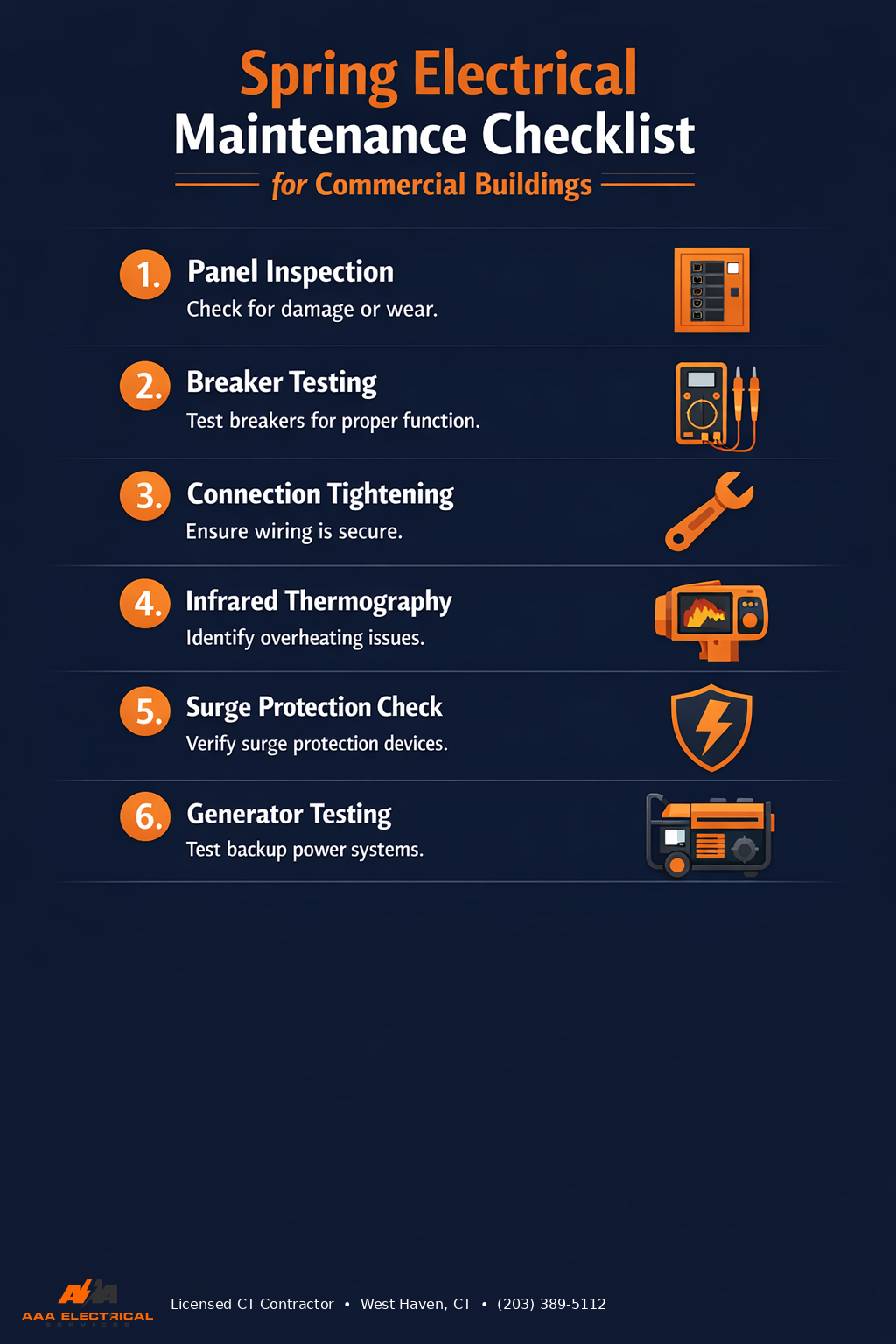
1. Panel Visual Inspection & Connection Tightening
First, we open the panel and look. Corrosion around connections? Moisture on components? Burn marks on terminals? Those tell us where problems live. Then we use a calibrated torque wrench to tighten every connection in the panel — main lugs, breaker terminals, grounding bus, neutral bus. Loose connections generate heat. Heat causes failures. Tight connections prevent both.
2. Breaker Functional Testing
Each breaker gets a manual trip test. We flip the handle to "Off," then back to "On." If the breaker trips easily and resets smoothly, it's good. If it's sluggish, stuck, or won't reset, it's failed and needs replacement. We check the "Test" button too — many breakers have a built-in test function that's diagnostically valuable.
3. Ground Fault & Arc Fault Testing
If your panel's got GFCI or AFCI breakers, they've got test buttons. We test every one. Some fail. Most pass but should be replaced anyway if they're more than 10 years old — they lose sensitivity over time. We always recommend replacement if they're showing age.
4. Infrared Thermography Scan
This is the secret weapon. We use an infrared camera to scan the entire electrical system — panel, disconnects, transformers, breakers, connections. Hot spots show up immediately. A connection that looks fine to the naked eye but runs 40°F hotter than it should? That's about to fail. We catch it and fix it before it causes a shutdown.
5. Load Testing & Phase Balance
We check that loads are balanced across the three phases. Unbalanced loads stress equipment, cause overheating, and shorten equipment life. We look at panel amperage distribution — if one phase is maxed out while others have headroom, that's a problem. We measure actual draws during normal operations, not theoretical values.
6. Surge Protection & Surge Protective Device (SPD) Testing
If your building's got surge protection — and it should — we test it. Some SPDs fail silently. We verify they're rated for your actual system voltage and that they haven't been compromised by a past surge. We replace any that show wear or age.
7. Emergency Generator & Transfer Switch Testing
If you've got backup power, spring's the time to verify it actually works. We test the automatic transfer switch — does it sense a main power outage? Does the generator start automatically? Does it load correctly? We run it under simulated load and verify fuel supply. An untested generator that fails during a real outage is useless.
Spring Is When You Catch Problems Before They Cost You
Most of the failures we find in summer started in winter. Schedule your spring electrical maintenance now — before the heat hits.
Call 203-389-5112Infrared Testing: Your Secret Weapon in Spring Maintenance
You can't see heat with your eyes. You can only feel it — and by then, damage has already started. Infrared thermography shows us exactly where your system's running hot.
In a commercial panel, a typical connection runs around 100–110°F under load. If we see a connection running 150°F or higher, we know there's a problem. It could be:
- A loose connection creating resistance
- A corroded terminal contact with poor conductivity
- A breaker lug that's failing internally
- An undersized wire for the load it's carrying
All of those cause heat. All of them lead to failure if you ignore them. Infrared finds them before they fail. That's why we include it in every spring maintenance visit.
What's a Spring Electrical Maintenance Visit Actually Cost in Connecticut?
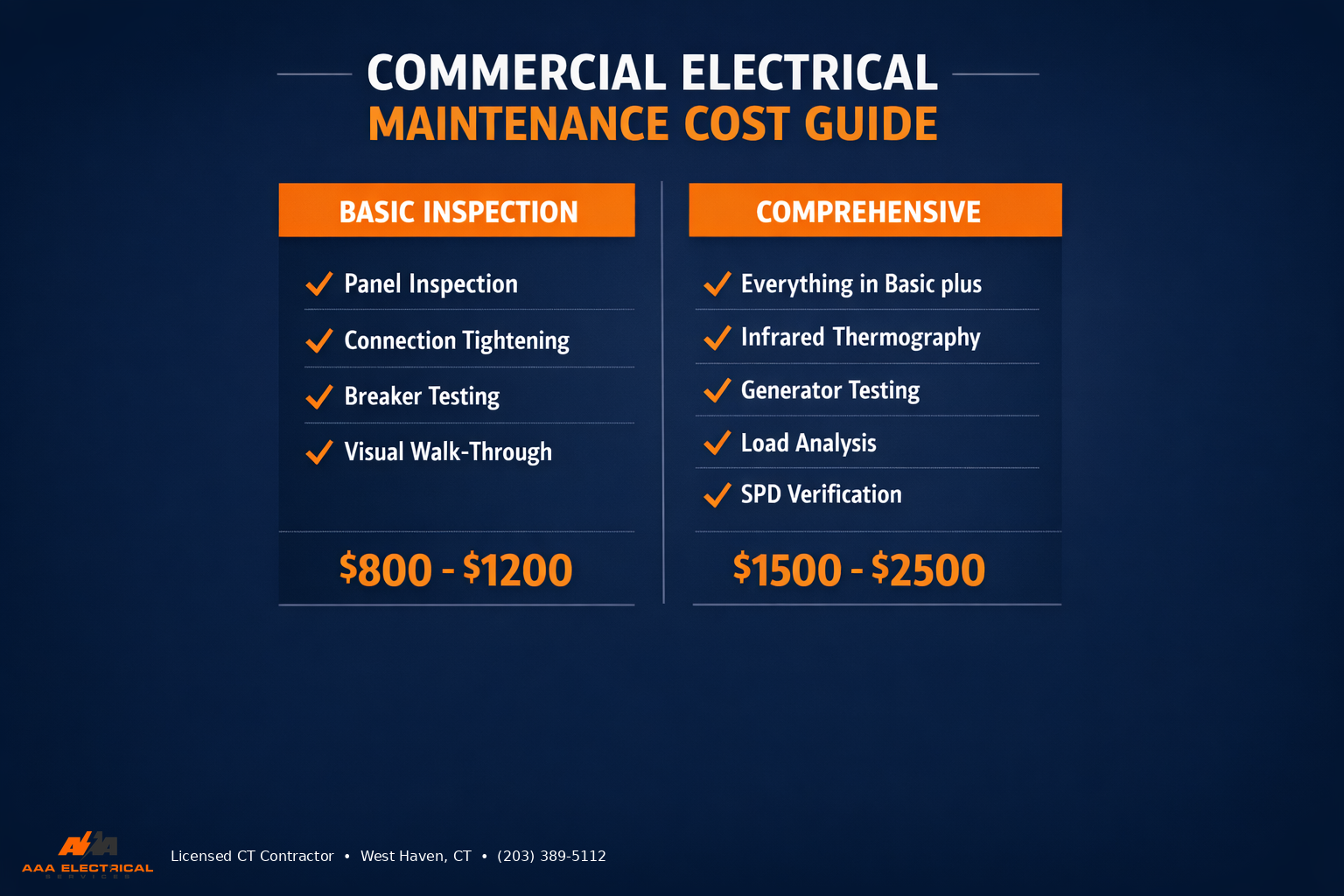
A basic spring electrical maintenance check runs $800–$1,200. That includes panel inspection, connection tightening, breaker testing, and a visual walk-through of your electrical infrastructure. We'll find obvious problems and tell you what needs fixing.
If you want the full deal — infrared thermography, generator testing, detailed load analysis, and SPD verification — plan on $1,500–$2,500 depending on your building's size and system complexity. Larger facilities with more panels, disconnects, and backup systems run higher. We'll quote you before we start work.
Any repairs we find get priced separately. We never bundle repairs into the inspection cost — you see what the inspection costs and what the fix costs. Clear pricing, no surprises.
Common Problems We Always Find Every Spring
After 17 years running service calls across New Haven and Fairfield Counties, we know what spring reveals. Here's what we see constantly:
Corroded Connection Lugs in the Panel
Moisture seeps into the panel enclosure during winter. If there's any air gap, condensation forms. Copper corrodes. We find green corrosion on terminal lugs at least 60% of the time during spring inspections in Connecticut. It gets worse if the building's near salt water. We clean the corrosion and retighten the connections.
Failed Breakers That Haven't Tripped Yet
A breaker that won't reset smoothly or trips on light loads is a sign of internal wear. We find at least one failed breaker per spring inspection — sometimes more on larger panels. Most are in service buildings that haven't had testing in years. Replacement's usually $150–$300 per breaker.
Overloaded Panels Running Out of Space
Businesses add new equipment — new HVAC zones, new circuits for renovations, new machinery. We see panels where the main disconnect is maxed out and there's no spare breaker space. That's code violation territory. It requires either panel relocation or an additional sub-panel. We handle both, but it's better to catch it in spring than face it during an expansion project.
Loose Grounding and Neutral Connections
These are the most dangerous finds. A loose ground or neutral connection causes voltage fluctuations throughout the building. Equipment fails prematurely. Sensitive electronics get damaged. We find loose grounds in maybe 40% of spring inspections — especially on older panels that haven't been serviced since installation.
Failing Surge Protection Devices
SPDs that are 5+ years old lose capacity. SPDs that have taken a surge and aren't rated for another one sit in your panel as dead weight. We replace about 30% of the SPDs we test during spring maintenance.
Don't Wait Until Summer — Schedule Your Spring Electrical Inspection Now
Every week you wait increases your risk. Summer heat loads hit your system hard. If your panel's got latent problems from winter — and it probably does — summer will expose them. An emergency call in July is more expensive and more disruptive than a scheduled maintenance visit in April.
We've been doing commercial electrical maintenance in Connecticut since 2009. We know what problems spring reveals. We know how to fix them. We know what fails and what doesn't.
Call us. We'll schedule a spring maintenance visit at a time that works for your building. Most inspections take 2–4 hours. We'll give you a written report of everything we find and a separate estimate for any repairs. Then you decide what to fix now and what to plan for later.
Based in West Haven, CT — Licensed CT Electrical Contractor #E1-0191759. We serve New Haven and Fairfield Counties. Call 203-389-5112 to schedule your spring electrical maintenance today.