Most business owners don't think about their electrical system until something goes wrong. But waiting for a failure can be expensive — and dangerous. Electrical problems cause fires, damage equipment, disrupt operations, and create liability issues.
The good news: most electrical problems announce themselves with warning signs. If you know what to look for, you can catch issues before they become emergencies. Here are five critical signs that your business needs an electrical safety inspection.
Sign #1: Lights Flickering or Dimming Without Reason
Occasional flicker when you turn on a heavy appliance is normal. But if your lights flicker randomly, dim without explanation, or brighten and dim throughout the day, something's wrong.
Flickering lights can indicate:
- Loose connections in panels, breakers, or wiring
- Overloaded circuits that can't handle peak demand
- Utility company voltage fluctuations (less common, but possible)
- Failing ballasts in fluorescent or LED fixtures
- Arc faults — dangerous partial breaks in wiring that create sparks
The concern isn't just annoyance. Flickering indicates loose connections, and loose connections generate heat. Heat causes insulation to break down. Broken insulation can lead to arcs, sparks, and fire.
If your business has flickering lights, you need a professional inspection. An electrician will check connections, test circuit loads, and use infrared thermography to identify hot spots that indicate loose connections or overloads.
Sign #2: Circuit Breakers Trip Frequently
A circuit breaker trips once every few years? Normal. They're protecting your wiring from overload.
A circuit breaker that trips every week? Every day? Multiple times per day? That's a problem.
Frequent breaker trips mean:
- Overloaded circuits — too many devices on one circuit
- Faulty wiring creating short circuits
- Failing equipment drawing excessive power
- Wet conditions causing ground faults (especially in basements or mechanical rooms)
- Arc fault issues — the breaker detecting dangerous partial breaks in wiring
Some business owners respond by upgrading to a higher-capacity breaker, or just resetting the breaker every time it trips. Don't do this. The breaker is doing its job — protecting your building. The problem isn't the breaker. It's the wiring or equipment it's protecting.
If a specific circuit trips repeatedly, stop using that circuit and call an electrician. They'll diagnose what's drawing too much power, find any shorts or ground faults, and fix the underlying problem.
Sign #3: You Smell Burning, Smoke, or Charred Plastic
This is an emergency. If you smell burning or see smoke coming from electrical outlets, panels, equipment, or wiring, shut off power immediately and call 911 and a licensed electrician.
A burning smell indicates:
- Arcing wires — electricity jumping between conductors
- Overheating insulation — about to fail
- Loose connections generating heat — creating fire risk
- Failed equipment — transformers, motors, or electrical controls
Electrical fires start slowly. You smell the burning insulation before you see flames. If you catch it early, an electrician can isolate and fix the problem. If you ignore it, you have a fire.
Don't wait. Address burning smells immediately.
Sign #4: Old Wiring or Outdated Electrical System
If your building is more than 30-40 years old and hasn't had a major electrical upgrade, your wiring is likely outdated. This includes:
- Knob-and-tube wiring — installed in buildings from 1900s-1930s, now a fire hazard
- Aluminum wiring — installed in 1960s-70s, prone to oxidation and overheating
- Insufficient grounding — older systems lack proper ground protection
- Undersized service — buildings built for 60-100 amp service now need 200+ amps
- No arc fault protection — modern code requires AFCI breakers, older systems lack them
Old wiring deteriorates. Insulation becomes brittle. Connections loosen. Connections generate heat. Heat accelerates breakdown. The system becomes a fire waiting to happen.
If your business occupies an older building, even if you haven't noticed problems yet, you should have a professional electrical inspection. Building inspectors often flag old wiring as a code violation. Your insurance company might require upgrades as a condition of coverage.
An inspection identifies what needs to be replaced and in what priority order. Some upgrades are critical (replace knob-and-tube wiring immediately). Others can be phased in (service upgrade, panel replacement).
Sign #5: Your Insurance Requires It or Inspection Reports Flag Issues
Insurance companies require electrical inspections for:
- New policies — underwriters want to verify the electrical system is safe before binding coverage
- Older buildings — properties over 40 years old, or those with old wiring
- High-risk uses — commercial kitchens, manufacturing, data centers, medical facilities
- Claims history — if you've had electrical issues, coverage might depend on documented repairs
- Renewal denial — insurers sometimes drop coverage if they won't certify the electrical system
Similarly, if a building inspection, code enforcement inspection, or property audit has flagged electrical issues, you need professional assessment.
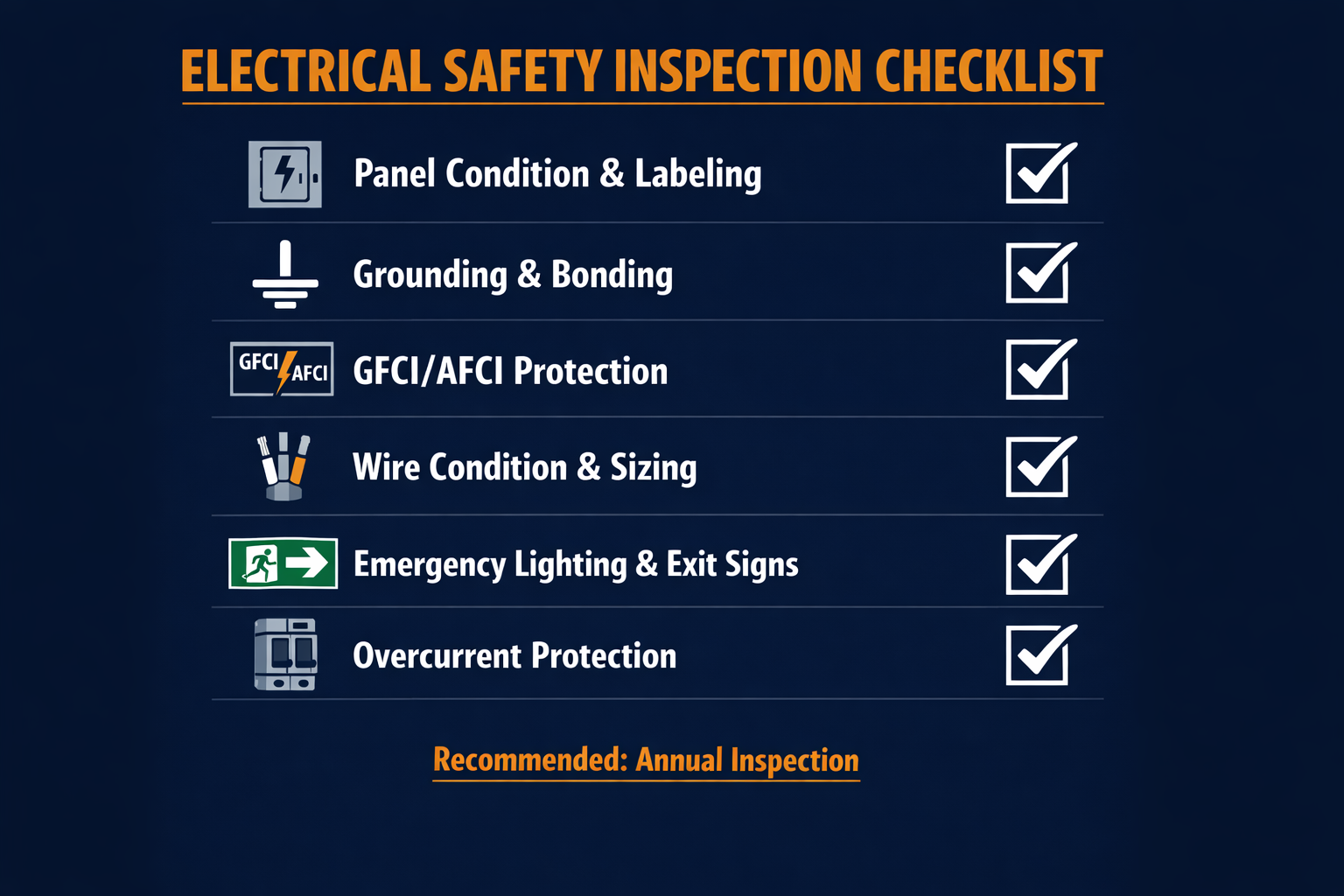
Common flagged items include:
- Overloaded circuits
- Missing or outdated breaker labels
- Improper grounding or bonding
- Missing GFCI protection in wet areas
- Old wiring or deteriorated insulation
- Undersized service for current electrical demand
These aren't just code violations. They're safety hazards. A professional inspection documents exactly what's wrong and what's needed to bring the system into compliance.
How an Electrical Safety Inspection Works
A thorough electrical safety inspection includes:
- Visual inspection of the main panel, breakers, grounding, and visible wiring
- Testing of circuits, voltage, continuity, and grounding
- Infrared thermal imaging to identify loose connections, overloaded circuits, and failing equipment without opening panels or disrupting power
- Load analysis to determine if your service can handle current and future needs
- Code compliance review checking against current NEC standards
- Written report identifying issues, priority level (emergency, urgent, future), and recommended repairs
Infrared thermography is especially valuable for commercial buildings. It reveals overheating without requiring you to shut down circuits or open equipment. You can see exactly where problems are, prioritize repairs, and budget accordingly.
What to Do If You Find Problems
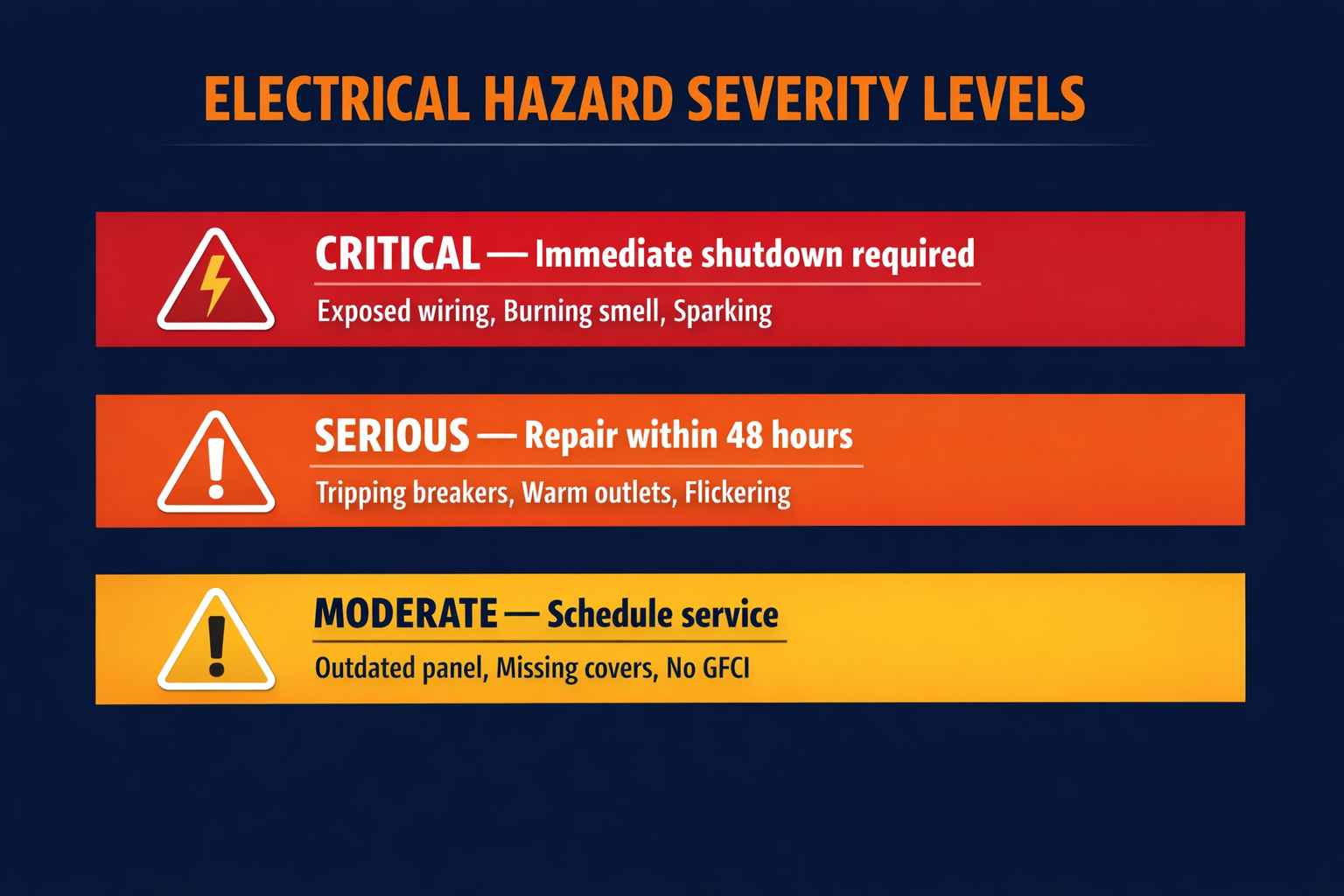
If an inspection identifies issues, don't panic. Most electrical problems are fixable. Here's how to prioritize:
Emergency (fix immediately): Burning smells, active arcing, exposed live wires, tripping breakers, missing grounds
Urgent (fix within 1-2 months): Old wiring (knob-and-tube, aluminum), undersized service, overloaded circuits, failing equipment
Planned (schedule in next 6-12 months): Code compliance upgrades, efficiency improvements, capacity expansion for future needs
A professional electrician will give you a phased approach so you can budget accordingly. You don't have to fix everything at once. But you should have a plan and a timeline.
Why Professional Inspection Matters
Some business owners try to DIY electrical diagnostics or hire unqualified electricians to cut costs. This is false economy.
An unpermitted or unlicensed repair might save you $1,000 today but costs you $100,000 in fire damage, equipment loss, or insurance denial tomorrow. Moreover, if someone gets hurt and the electrical work wasn't licensed, you're personally liable.
A licensed, insured electrician brings expertise. They know code. They know what safe looks like. They pull permits when required. They stand behind their work. Most importantly, they carry insurance, so if something goes wrong, you're protected.
The cost of a professional electrical inspection is a fraction of the cost of fixing problems after they cause damage. And it's free compared to the risk of a fire or a costly insurance denial.
Your Next Step
If any of these five signs apply to your business, call a licensed CT electrician for an inspection. If you're in southern Connecticut, we do comprehensive commercial electrical inspections using infrared thermography, circuit testing, and code compliance review. We'll give you a detailed report with priorities and estimated costs so you can make informed decisions.
AAA Electrical Services: 203-389-5112. Based in West Haven, serving Fairfield and New Haven counties since 2009. Licensed (CT #E1-0191759), insured, and all work guaranteed.
Schedule Your Electrical Safety Inspection
Professional assessment — no obligation. We'll identify issues, prioritize repairs, and give you pricing.
Call 203-389-5112