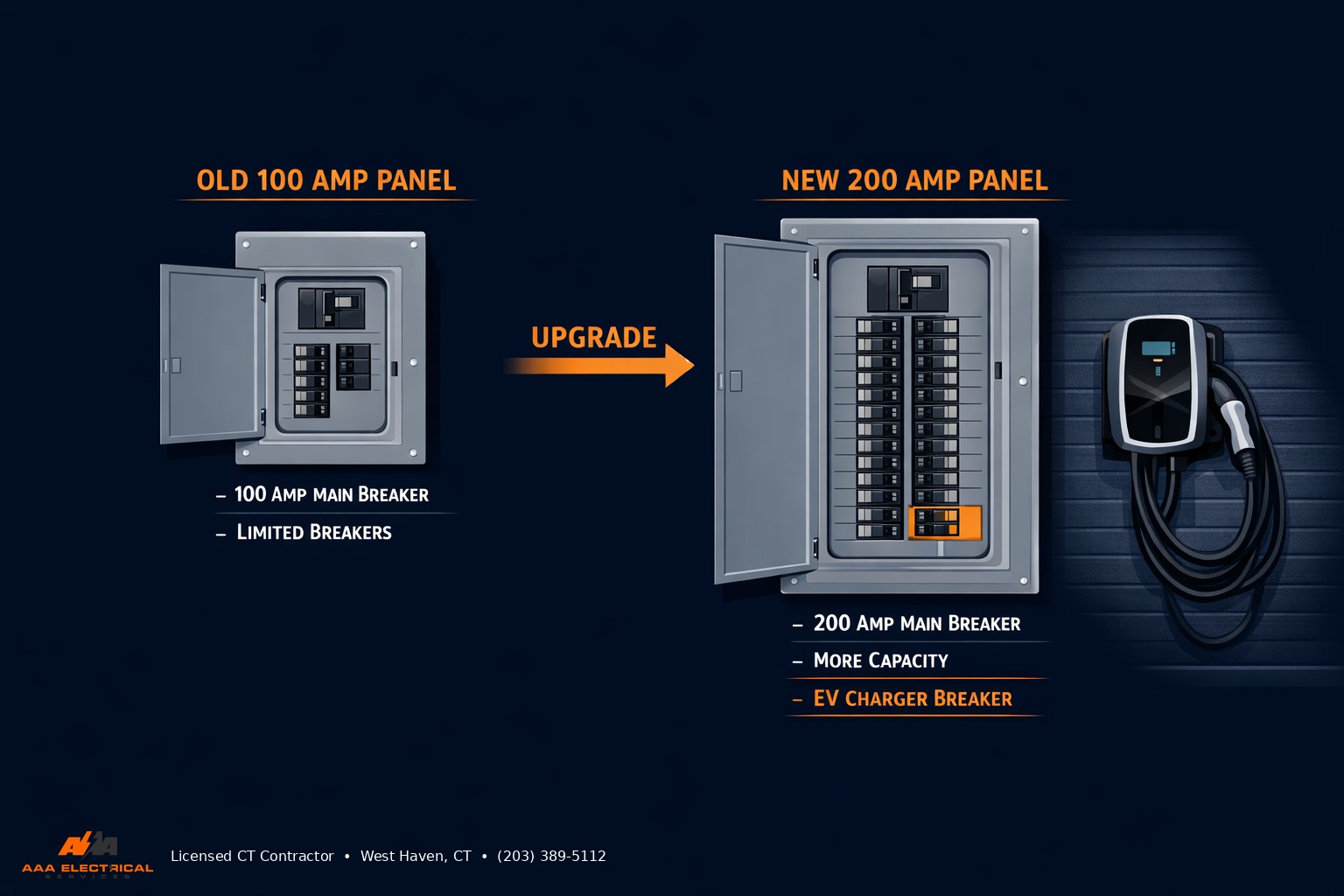
You call an electrician about installing an EV charger. They take one look at your electrical panel and say: "You're going to need an upgrade." Suddenly your $1,500 charger project is looking more like $4,000.
Is that real, or are you being upsold? As a licensed electrician who's done hundreds of EV charger installations across Connecticut, here's the honest answer: about 40% of the homes we visit need a panel upgrade before we can install a Level 2 charger. The other 60% are fine as-is.
Here's how to figure out which camp you're in—and what it costs if you do need the upgrade.
Why EV Chargers Need So Much Power
A Level 2 EV charger is one of the most power-hungry appliances you can add to a home. Here's some context:
- Electric dryer: 24–30 amps on a 240V circuit
- Central air conditioning: 30–50 amps on a 240V circuit
- Electric water heater: 20–30 amps on a 240V circuit
- Level 2 EV charger: 32–48 amps on a 240V circuit
An EV charger at 48 amps draws about the same power as running your central AC and electric dryer at the same time. That's a significant load, and your panel needs enough capacity to handle it on top of everything else in your home.
The National Electrical Code (NEC) requires that a continuous load (like an EV charger that runs for hours) be served by a circuit breaker rated at 125% of the charger's amperage. So a 48-amp charger needs a 60-amp breaker. A 40-amp charger needs a 50-amp breaker. A 32-amp charger needs a 40-amp breaker.
100 Amp vs 200 Amp Panels: What's in Your Home?
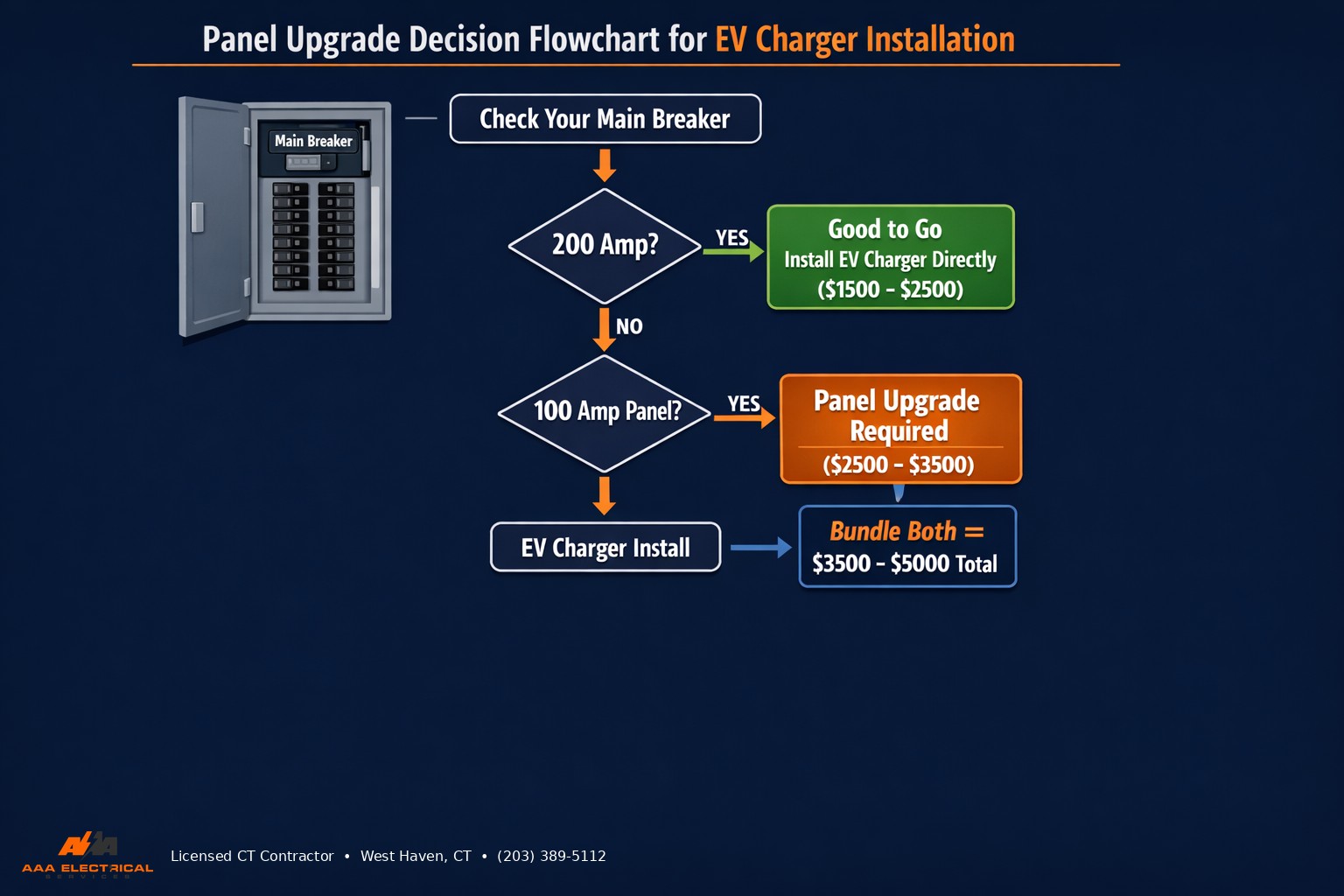
The first thing we check is your panel's total service capacity. In Connecticut, we see three common scenarios:
60-amp or 100-amp panels: These are common in older CT homes built before the 1980s. Many homes in New Haven, West Haven, Bridgeport, and other older towns still have 100-amp service. With a 100-amp panel, you typically have 70–80 amps of existing load from your HVAC, water heater, kitchen appliances, and general circuits. Adding a 40–60 amp EV charger circuit puts you over capacity. You'll almost certainly need an upgrade.
150-amp panels: Less common but we see them occasionally. Whether you need an upgrade depends on your existing load. We'll calculate it during the site assessment.
200-amp panels: Standard in homes built after the 1990s and in many renovated older homes. A 200-amp panel typically has enough headroom for an EV charger without any panel work. Most 200-amp panels can handle an EV charger with no upgrade.
How to Check Your Panel Size
Look at the main breaker at the top of your panel. It's the large breaker that feeds everything else. It will say "100," "150," or "200" on it. That's your panel's total amperage rating.
If it says 100 or less, you should plan for a possible upgrade. If it says 200, you're probably good—but a load calculation will confirm.
Not Sure What You Have? We'll Check for Free
We'll inspect your panel, calculate your load, and tell you exactly what's needed for an EV charger installation. No obligation.
Call 203-389-5112The Load Calculation: How We Decide
We don't guess. We run a load calculation per NEC Article 220. We add up every major load in your home—HVAC, water heater, range, dryer, kitchen circuits, lighting—apply NEC demand factors (not everything runs at once), and compare that total to your panel's capacity.
Then we add the EV charger: a 48-amp charger adds 11,520 watts (48A × 240V). A 32-amp charger adds 7,680 watts.
If the total demand exceeds your panel capacity, you need an upgrade. If there's headroom, we install the charger on your existing panel. No guessing, no upselling—just math.
What a Panel Upgrade Actually Involves
A panel upgrade isn't just swapping one box for another. Here's what happens during a typical 100A to 200A upgrade in Connecticut:
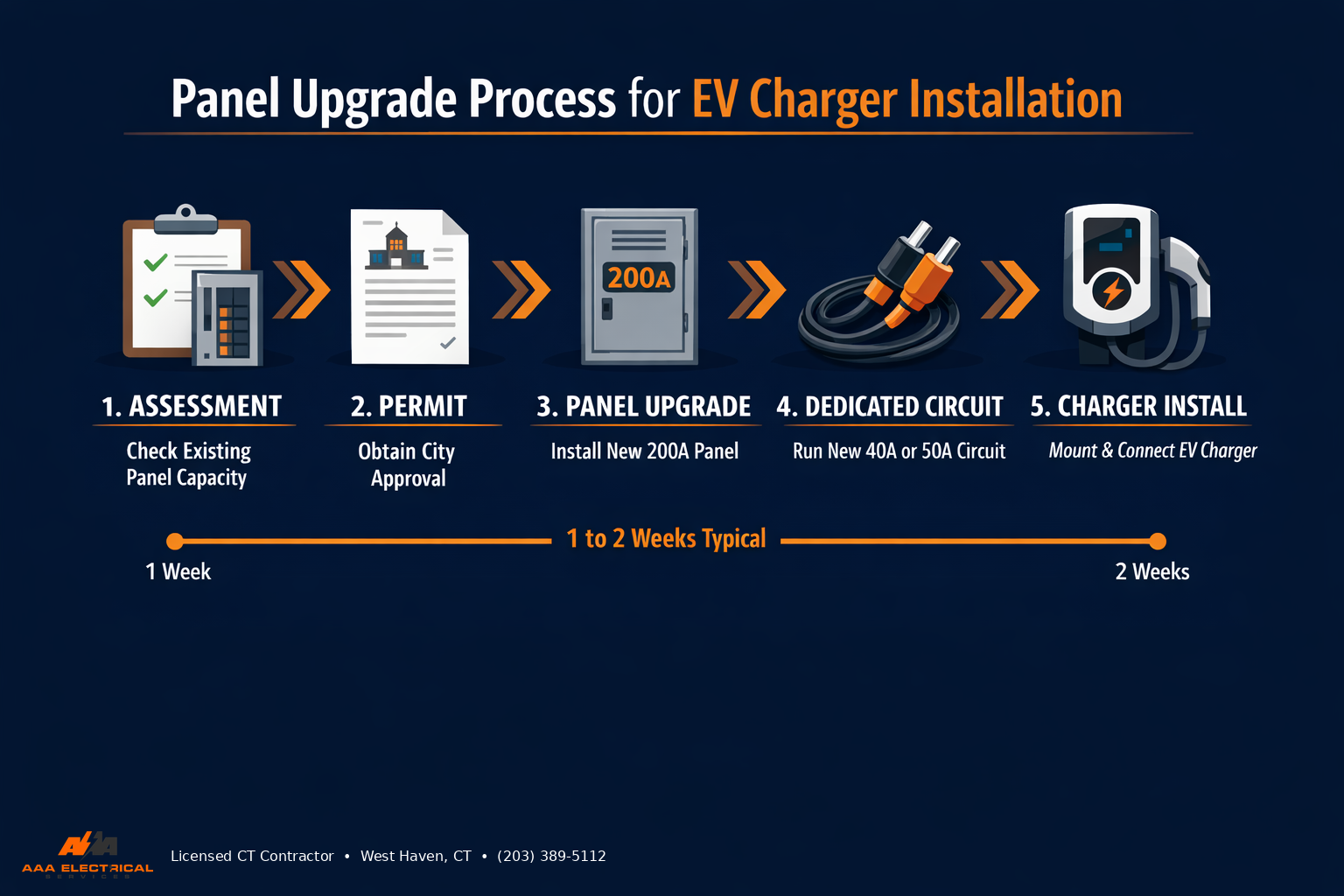
Step 1: We pull a permit. Every panel upgrade in CT requires a municipal electrical permit. We handle the application. Most towns approve permits within 5–10 business days.
Step 2: Eversource or UI coordination. The utility company needs to disconnect your power temporarily during the upgrade and may need to replace the meter base. We coordinate the scheduling.
Step 3: Replace the panel. We install a new 200-amp panel with modern circuit breakers. All existing circuits get transferred to the new panel. We also replace the service entrance cable (the heavy wire from the meter to the panel) if it's undersized.
Step 4: Install the EV charger circuit. While we're in the panel, we add the dedicated 240V circuit for your charger. This is the most efficient time to do it—the panel is already open and we're already on site.
Step 5: Inspection. The municipal electrical inspector comes out, verifies the work meets code, and signs off. Eversource or UI reconnects your service.
Total time: The panel upgrade itself takes about one day (6–8 hours). The full process including permits and inspection typically spans 2–3 weeks.
What Does a Panel Upgrade Cost in Connecticut?
Panel upgrade pricing in CT depends on the scope of work. Here are typical ranges we see across New Haven and Fairfield Counties:
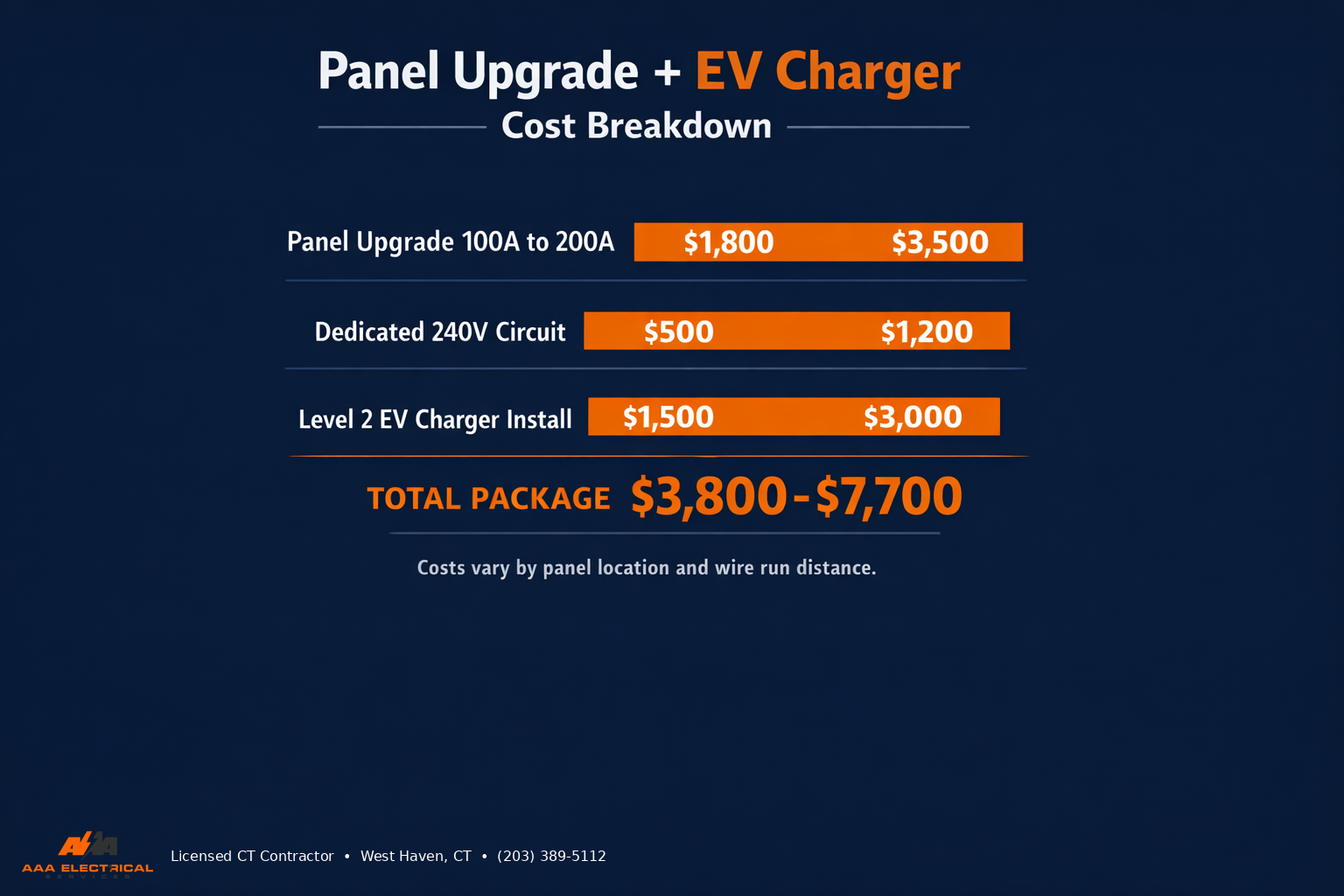
- 100A to 200A panel upgrade (standard): $2,500–$3,500. This includes the new 200A panel, breakers, labor, permit, and inspection. The service entrance cable is in good condition and the meter base doesn't need replacement.
- 100A to 200A with meter base replacement: $3,500–$4,500. Some older homes have meter bases that can't accept 200A service. The utility may require a new meter socket, which adds cost.
- 100A to 200A with service entrance cable replacement: $3,000–$4,000. If the cable from the meter to the panel is undersized aluminum or deteriorated, it needs replacement.
- Full service upgrade (panel + meter base + cable): $4,000–$5,500. This is the worst case for older homes that need everything replaced.
Adding the EV charger installation on top: If we're already doing a panel upgrade, the incremental cost to add the EV charger circuit is lower—typically $500–$800 for the circuit work plus the charger cost ($400–$620). We're already in the panel, already on site, already have the permit.
Bundle pricing: Panel upgrade + EV charger installation together typically runs $3,500–$5,000 total, depending on the panel scope and charger model. That's significantly less than doing them as separate projects.
Alternatives to a Full Panel Upgrade
A full panel upgrade isn't always the only option. Depending on your situation, these alternatives might work:
Lower-Amperage Charger
Instead of a 48-amp charger that needs a 60-amp breaker, you can install a 24-amp or 32-amp charger that needs only a 30-amp or 40-amp breaker. You'll charge slower (16–25 miles of range per hour instead of 30–44), but for overnight charging that's usually fine. This might fit within your existing panel capacity.
Load Management Device
Some smart chargers and load management devices can share capacity with other circuits. For example, they'll reduce EV charging amperage when your AC kicks on, then ramp back up when the AC cycles off. This keeps your total load within your panel's capacity without an upgrade. The charger charges slower during peak demand periods, but faster overnight when other loads drop off.
Sub-Panel
If your main panel has available amperage but no available breaker slots, a sub-panel is a simpler and cheaper option than a full panel swap. A sub-panel is a smaller panel fed from your main panel, typically installed closer to where the charger will be mounted (like in a garage). Cost: $800–$1,500.
We always explore alternatives before recommending a full panel upgrade. If there's a way to install your charger safely without replacing the panel, we'll find it.
Signs Your Panel Probably Needs an Upgrade (Even Without an EV Charger)
Sometimes the EV charger is just the tipping point for a panel that was already overdue for replacement. Here are warning signs:
- Breakers trip frequently. Running the microwave and hair dryer at the same time shouldn't kill the lights. If it does, you're overloaded.
- Panel is warm to the touch. Heat means resistance. Resistance means connections are degrading. That's a fire risk.
- You have a Federal Pacific or Zinsco panel. These brands are documented fire hazards. Replace it—EV charger or not.
- Fuses instead of breakers. Fuse panels can't safely support modern loads. Time for an upgrade.
If any of these apply, a panel upgrade is a smart investment for safety and home value—and it sets you up for an EV charger at the same time.
Panel Upgrade + EV Charger: One Project, One Permit
We'll handle the panel upgrade and charger installation together. Saves you time, money, and a second inspection. Plus, the federal 30C tax credit covers the charger portion.
Call 203-389-5112The 30C Credit Covers the Charger (Not the Panel)
Quick clarification: the federal 30C tax credit covers 30% of your EV charger installation—up to $1,000 for residential. That includes the charger, the dedicated circuit, and the labor to install it.
The panel upgrade itself isn't covered by 30C. But bundling both projects saves you money on labor and permitting. And the panel upgrade adds real value to your home either way.
From first call to charging your car, the whole process takes 3–5 weeks with a panel upgrade, or 2–3 weeks without. The federal 30C tax credit expires June 30, 2026—even with a panel upgrade, there's still time. But don't wait.
Related Articles
Find Your Town
We install EV chargers and upgrade panels across southern Connecticut. Find your town: