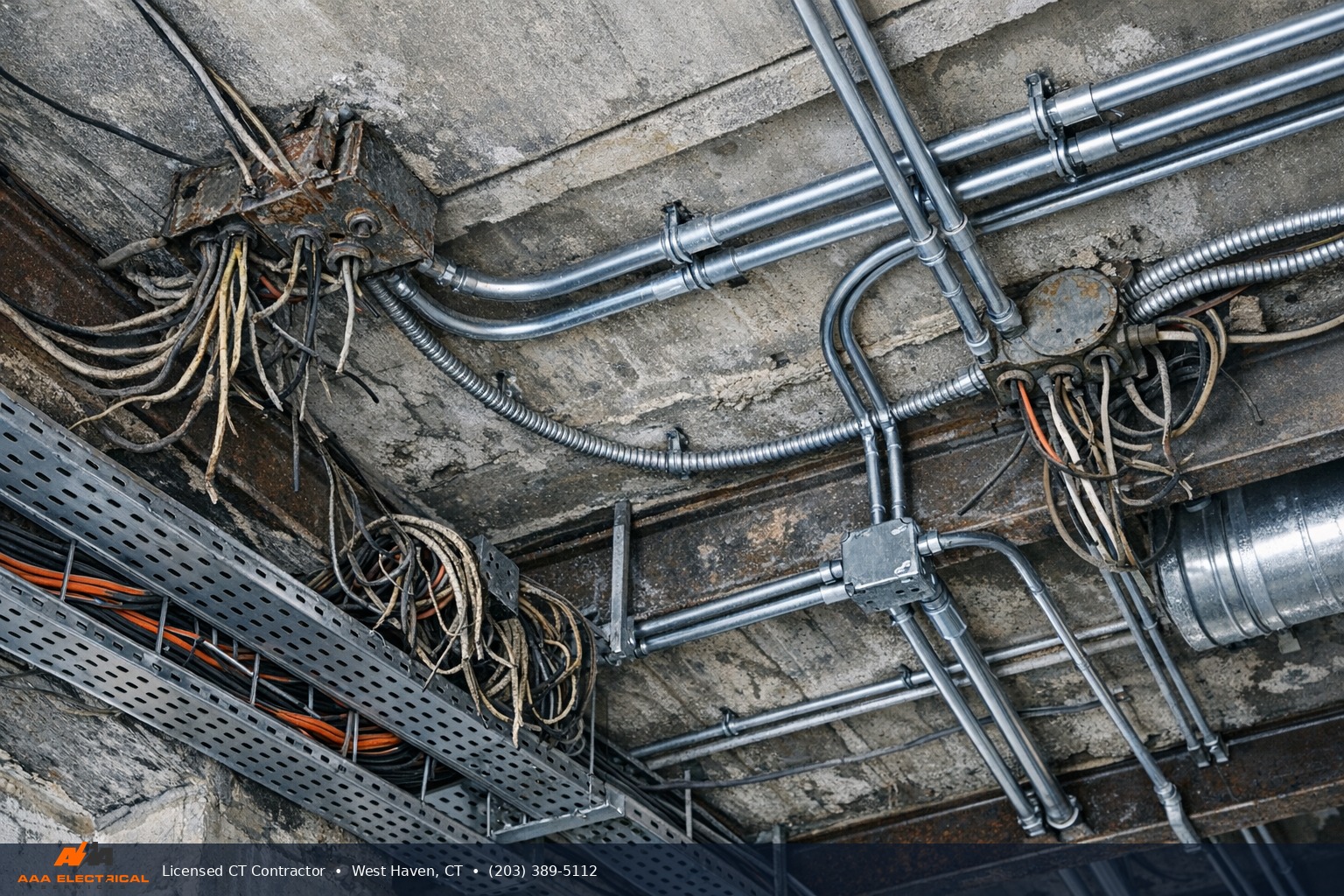
Commercial buildings in Connecticut don't get rewired often enough. A property might have had solid electrical work in 1975 — but 50 years later, that wiring is undersized, corroded, or just plain dangerous.
If you own or manage a commercial building and you're seeing any of the warning signs below, it's time to call an electrician. Waiting just increases the risk — and the cost.
1. Your Building Is Older Than 25 Years
If your building was wired before 2000, the electrical system wasn't designed for today's loads. Back then, offices had a few computers, some fluorescent lights, and a coffee maker. No server racks. No EV chargers. No LED retrofit controllers.
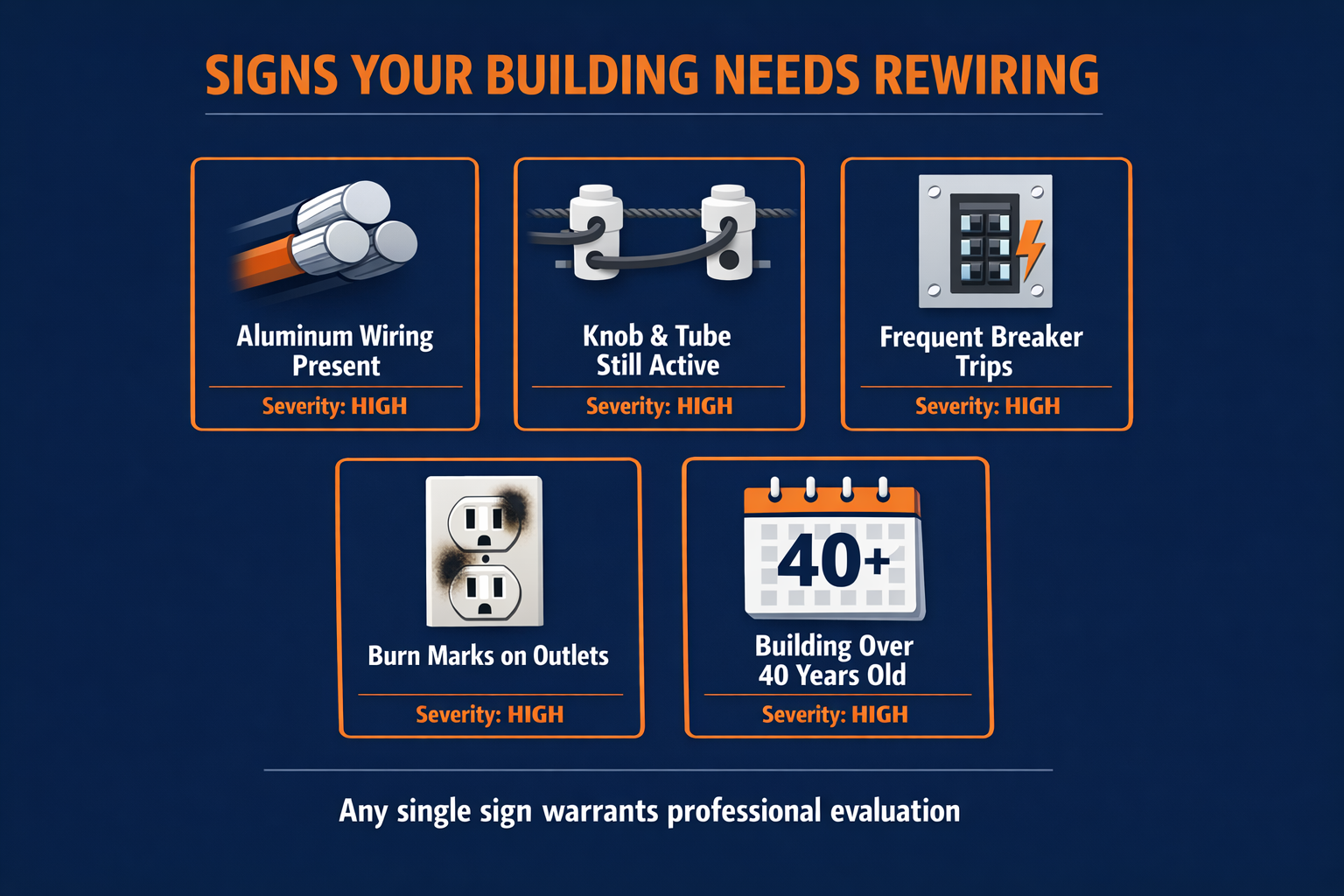
Older buildings often have aluminum wiring (common in the '60s and '70s), undersized panels, and wiring that doesn't meet current National Electrical Code (NEC) standards. Aluminum wiring is a particular problem — it expands and contracts with temperature changes, which loosens connections and creates fire hazards.
If your building is 25+ years old and hasn't been rewired, you're overdue. Especially if you've added tenants, upgraded HVAC, or installed new equipment.
2. Lights Flicker or Dim When Equipment Turns On
This is voltage drop. It happens when your electrical system can't supply consistent power under load. Maybe the lights dim when the HVAC compressor kicks on. Maybe they flicker when someone across the building turns on a piece of machinery.
That tells you the wiring is undersized for the load, or there are loose connections somewhere in the system. Both are fire risks. Voltage drop also damages sensitive equipment — computers, printers, medical devices — by subjecting them to unstable power.
If this is happening regularly, your building needs commercial building rewiring or at minimum a serious electrical upgrade.
3. Circuit Breakers Trip Constantly
Circuit breakers are designed to trip when a circuit overloads. It's a safety feature. But if your maintenance team is resetting breakers every week — or every day — that's not normal operation. That's a system crying for help.
Frequent breaker trips mean your circuits are overloaded, your wiring is failing, or your breakers themselves are worn out. You need a licensed electrician to do a load analysis and figure out where the problem is.
In many cases, the fix is adding circuits and upgrading the panel. In older buildings, it means a full rewire.
Don't Ignore Tripped Breakers
Ignoring tripped breakers is dangerous. Every time a breaker trips, it's telling you the system is being pushed past its limits. If you just keep resetting it, you're gambling that the wiring can handle the overload. Eventually, it can't — and that's when fires start.
4. Outlets, Switches, or Panels Feel Warm
Electrical components should never be warm to the touch. If an outlet, light switch, or panel feels warm — or worse, hot — you have a serious problem. That's a sign of loose connections, overloaded circuits, or failing equipment.
Shut down that circuit immediately and call an electrician. Don't wait. Heat is the precursor to fire. We've responded to too many emergency calls where a "warm outlet" turned into a panel fire because someone waited too long.
If you manage a multi-tenant building and a tenant reports a warm outlet, treat it as urgent. Get it inspected same-day if possible.
5. You Smell Burning Plastic or See Scorch Marks
This is the red-alert warning sign. If you smell burning plastic near an outlet, panel, or junction box — or if you see scorch marks, melted insulation, or discolored outlets — you've got active electrical failure happening.
Shut off power to that area and call an emergency electrician. Do not ignore this. Electrical fires in commercial buildings spread fast, especially in older buildings with combustible wall materials.
Scorch marks around outlets or panels mean arcing has occurred. Arcing generates temperatures hot enough to ignite wood, insulation, and drywall. If you're seeing evidence of arcing, your wiring system is failing and needs replacement.
When Does Rewiring Make Sense?
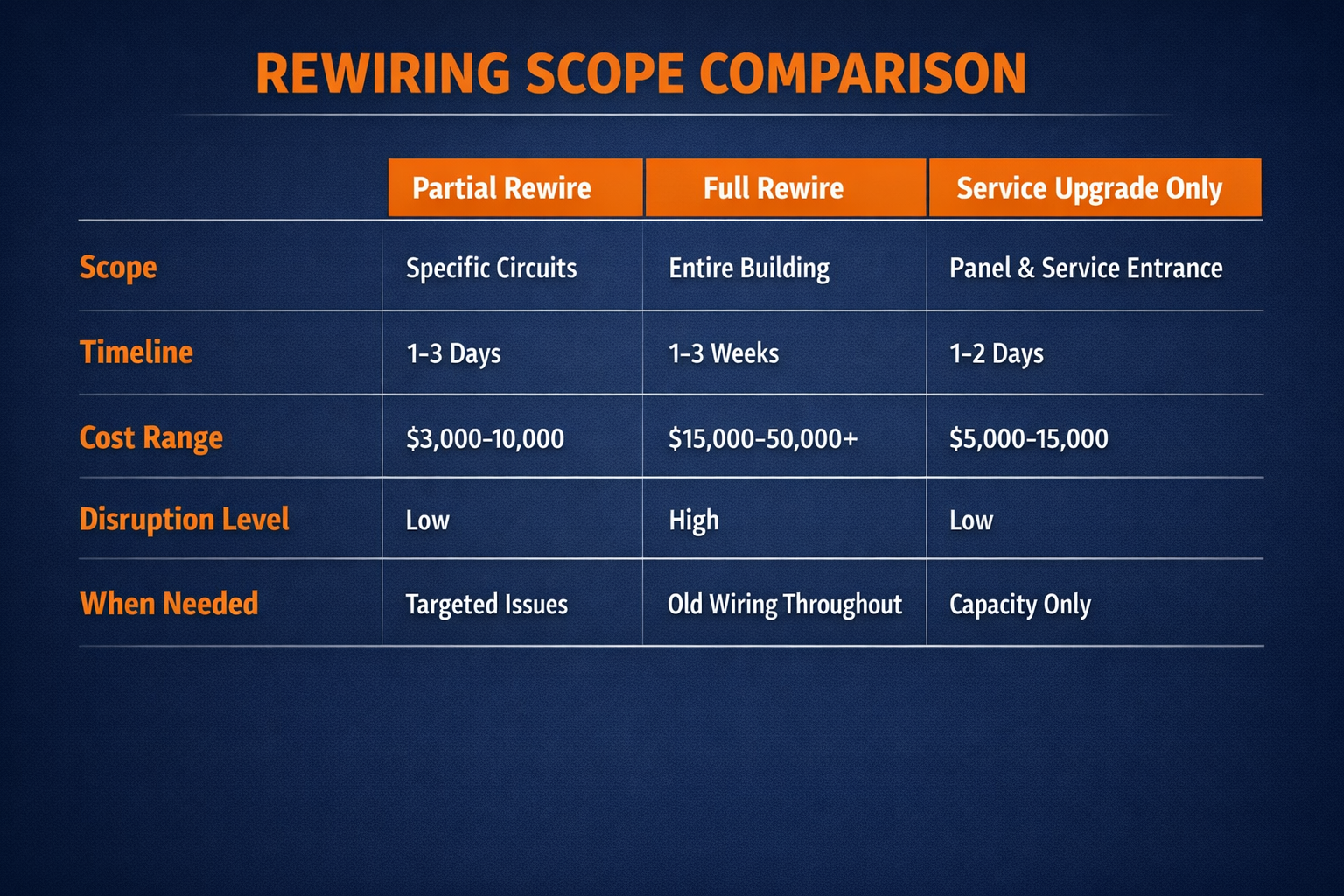
If your building is showing multiple warning signs — flickering lights AND frequent breaker trips AND warm outlets — you're past the point of patchwork repairs. You need a full electrical system evaluation and likely a rewire.
Rewiring a commercial building isn't cheap, but it's a hell of a lot cheaper than rebuilding after a fire. And if you're planning a renovation, tenant improvement, or building expansion, that's the perfect time to rewire. The walls are already open — you'll save on labor.
What Does Commercial Rewiring Involve?
Here's the process:
- Load analysis: We calculate your building's current and future electrical needs.
- Panel upgrade: Most rewires include upgrading to a larger panel (or multiple panels) with modern circuit breakers.
- New wiring: We replace old wiring with properly sized copper conductors run through conduit or cable assemblies that meet current NEC code.
- Circuit distribution: We add circuits where needed so tenants have adequate power without overloading.
- Grounding and bonding: Modern electrical systems require proper grounding. Older buildings often don't have it.
- Code compliance: Everything gets brought up to current Connecticut electrical code.
- Permits and inspections: We handle all permits and inspections through your local building department.
Timeline depends on building size and scope of work. A 5,000-square-foot office building might take a week. A 30,000-square-foot industrial building could take a month. We schedule work to minimize disruption to tenants and operations.
Don't Wait for a Fire
Commercial electrical fires are preventable. Most of the time, there are warning signs — flickering lights, tripped breakers, warm outlets. If you're managing a building in New Haven, Milford, Hamden, or anywhere in southern Connecticut and you're seeing those signs, call us.
We've been doing commercial electrical work since 2009. We handle everything from small office rewires to full industrial facility buildouts. Licensed (CT #E1-0191759), insured, and we work with your schedule to keep your building operational. Call 203-389-5112 for a free evaluation.
Need Help With This?
AAA Electrical Services has been doing this work across Southern CT for 17+ years.
Call 203-389-5112Related Services
Find Your Town
We provide commercial electrical services across southern Connecticut. Find your town for local service information: