
There's no shortage of people calling themselves electricians in Connecticut. Some are licensed, skilled professionals. Some are handymen with a screwdriver and a YouTube account. Hiring the wrong one can cost you — in money, safety, and code violations.
Here's how to find a real electrical contractor and avoid the hacks.
Step 1: Verify the Connecticut License
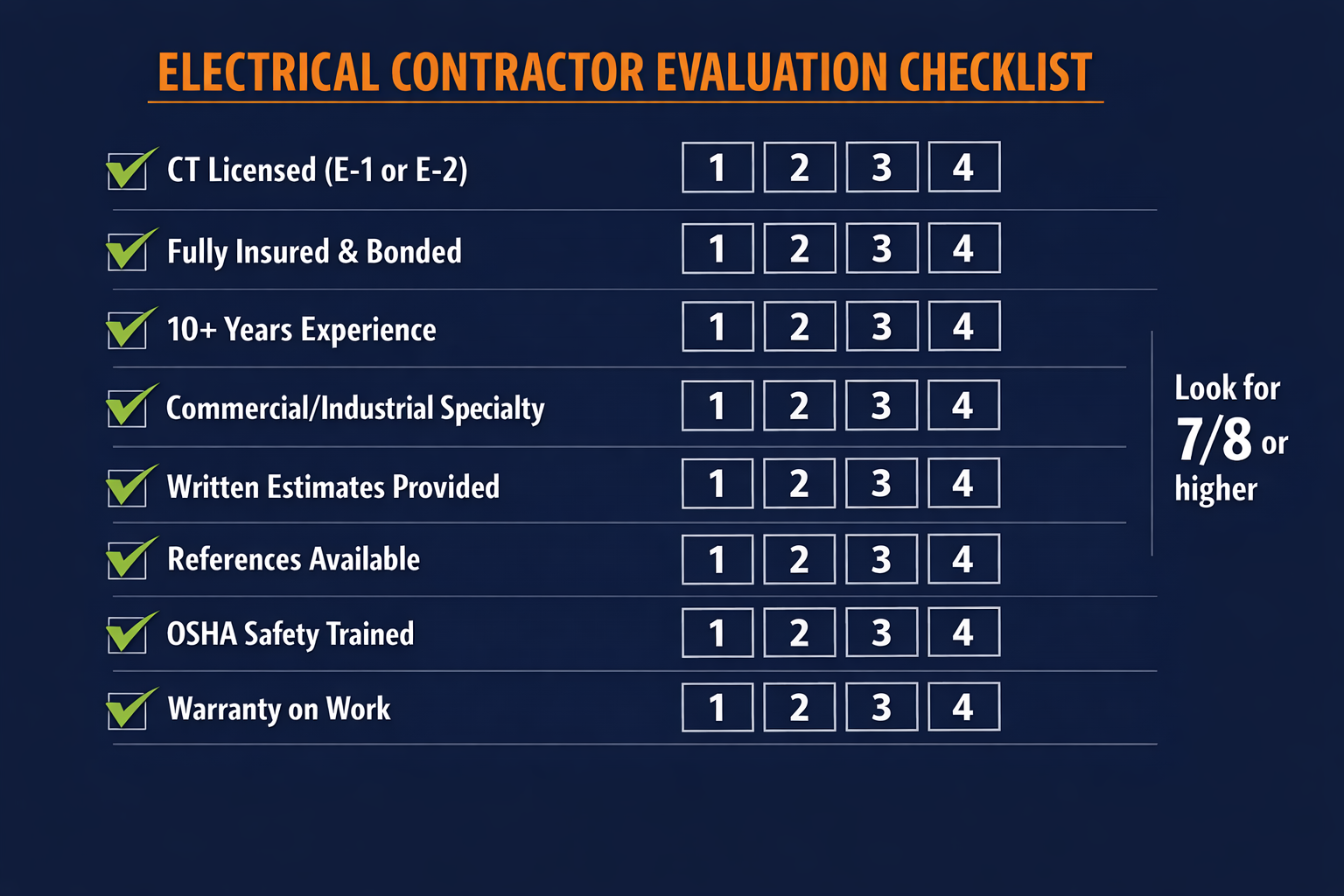
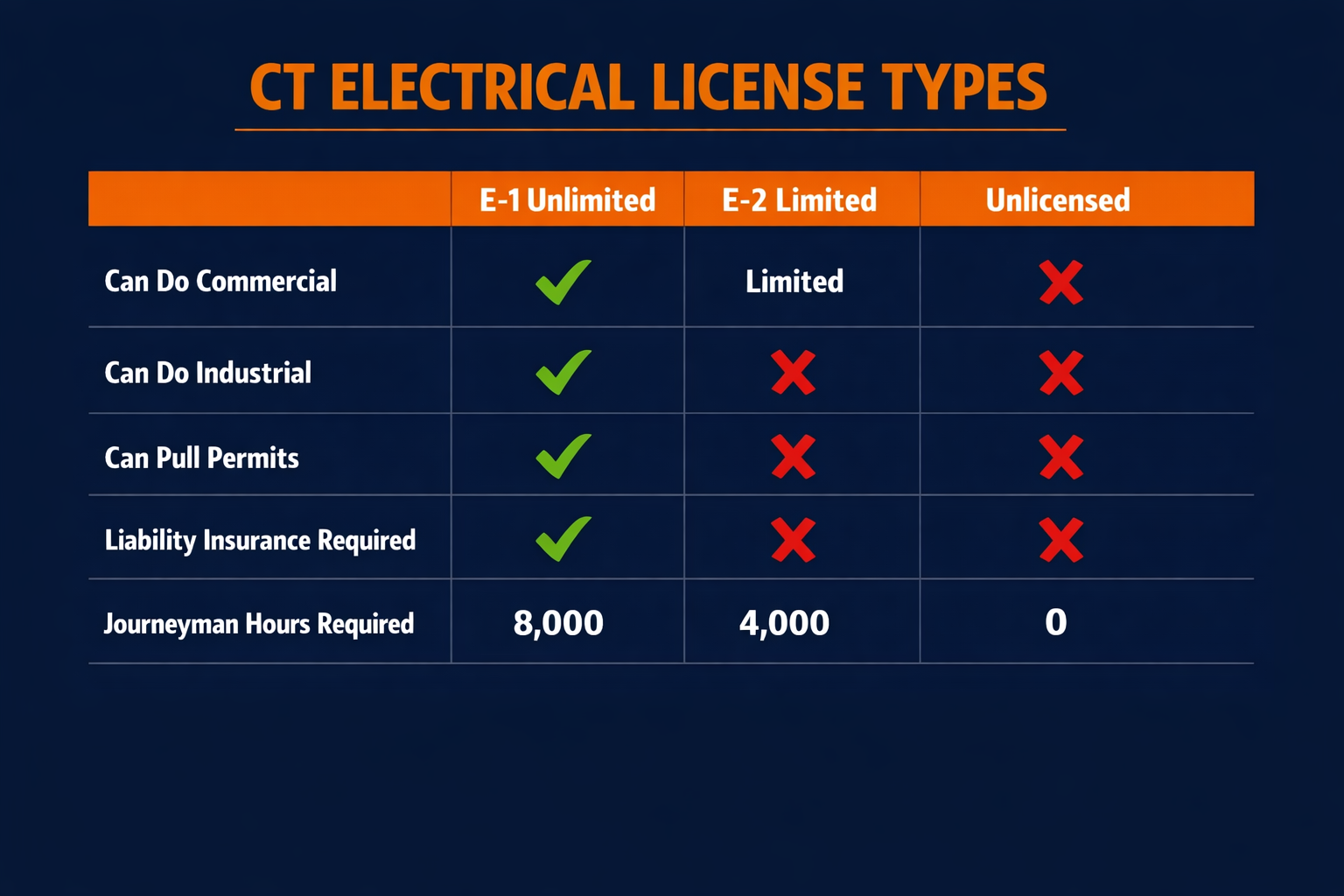
Connecticut requires all electricians to be licensed by the Department of Consumer Protection (DCP). There are different license types — E-1 Unlimited Electrical Contractor, E-2 Journeyperson, C-5 Limited (low-voltage only) — but if someone's doing electrical work in your home or business, they need to hold a valid license.
Ask for the license number. Then verify it using the CT DCP license verification tool. Don't just take their word for it. Anyone can print a fake license. The state database doesn't lie.
If they won't give you a license number, or if the license comes back expired or invalid, walk away. Unlicensed electrical work is illegal in Connecticut, voids your homeowner's insurance, and creates serious liability if something goes wrong.
Step 2: Confirm Insurance Coverage
Every electrical contractor in Connecticut is required to carry workers' compensation insurance — even if they're self-employed. They should also carry general liability insurance to cover property damage.
Ask for proof of insurance. A real contractor will hand you a certificate of insurance without hesitation. If they dodge the question or say "I'm insured, don't worry about it," that's a red flag.
Why does this matter? Because if an unlicensed, uninsured electrician gets hurt on your property, you're liable. If they burn your house down, your insurance won't cover it because the work was done by an unlicensed contractor. Don't take that risk.
Step 3: Get Multiple Quotes (But Don't Just Pick the Cheapest)
Get at least three quotes for any electrical job. That gives you a sense of what the work should cost and helps you spot lowball bids that are too good to be true.
The cheapest quote is usually cheap for a reason. Maybe they're skipping permits. Maybe they're using substandard materials. Maybe they're not licensed. Maybe all three.
A good quote should include:
- Scope of work (exactly what they're doing)
- Materials and labor costs broken out
- Permit costs (if applicable)
- Timeline
- Payment terms
- Warranty information
If a quote is vague or missing details, ask for clarification. You should know exactly what you're paying for.
Step 4: Ask About Permits and Inspections
Most electrical work in Connecticut requires a permit from your local building department. Panel upgrades, circuit additions, service upgrades, EV charger installs — they all need permits.
A licensed contractor will pull the permit, schedule the inspection, and make sure the work passes. If someone tells you "we don't need a permit for this" or "permits are optional," that's a massive red flag. They're either ignorant of the code or trying to cut corners.
Unpermitted electrical work is a problem when you sell your home. It voids warranties. And if there's a fire, your insurance can deny the claim if they find out the electrical work wasn't permitted.
Always ask: "Are you pulling a permit for this?" The answer should be yes.
Step 5: Check Reviews and References
Google reviews, Yelp, HomeAdvisor — they all give you a sense of how a contractor operates. Look for patterns. One bad review might be a fluke. Ten bad reviews is a trend.
Pay attention to how the contractor responds to negative reviews. Do they take responsibility and try to fix the issue? Or do they get defensive and blame the customer? That tells you a lot about how they handle problems.
Also ask the contractor for references — recent jobs similar to yours. Call those references and ask:
- Did the contractor show up on time?
- Did they finish when they said they would?
- Was the final cost close to the estimate?
- Did the work pass inspection?
- Would you hire them again?
If a contractor won't give you references, that's a problem.
Step 6: Look for Experience in Your Type of Work
Not all electricians do all types of work. Some specialize in residential. Some do commercial and industrial. Some focus on service and repair. Some do new construction.
If you need a commercial tenant improvement with three-phase power and fire alarm integration, don't hire a guy who only does residential service calls. Find someone with commercial experience.
Ask about their experience with your specific type of project. How many panel upgrades have they done? How many EV chargers have they installed? Have they done infrared electrical testing on commercial buildings?
Experience matters. A contractor who's done 200 panel upgrades knows the tricks, the potential problems, and how to avoid surprises. Someone doing their first one is learning on your job.
Step 7: Watch for Red Flags
Here's what to avoid:
- No license or insurance — walk away immediately
- Cash-only, no receipt — that's tax evasion and you have no documentation
- Pressure to pay upfront — legit contractors ask for a deposit (10–30%), not full payment before work starts
- "We don't need a permit" — yes, you do
- Vague estimates — "around $2,000" isn't a quote; get it in writing
- No physical address — if they only have a cell phone and a P.O. box, they're not a real business
- High-pressure sales tactics — "This price is only good today" is a scam move
Trust your gut. If something feels off, it probably is.
Step 8: Get It in Writing
Never start work on a handshake. Get a written contract that spells out:
- Scope of work
- Materials to be used
- Total cost
- Payment schedule
- Start and completion dates
- Who's responsible for permits and inspections
- Warranty terms
Both you and the contractor should sign it. That protects both of you if there's a dispute.
Why This Matters
Electrical work isn't like painting a room. If it's done wrong, people die. Houses burn. Equipment gets destroyed. Insurance claims get denied.
Hiring a licensed, insured, experienced electrical contractor costs more than hiring some guy off Craigslist. But the difference in price is nothing compared to the cost of a fire, a failed inspection, or a code violation that tanks your home sale.
We've been doing electrical work across New Haven and Fairfield counties since 2009. Licensed (CT #E1-0191759), insured, and we pull permits for every job that requires one. We show up when we say we will, we finish on time, and we stand behind our work. Call 203-389-5112 for a free estimate.
Need Help With This?
AAA Electrical Services has been doing this work across Southern CT for 17+ years.
Call 203-389-5112Related Services
Find Your Town
We provide licensed electrical services across southern Connecticut. Find your town for local service information: