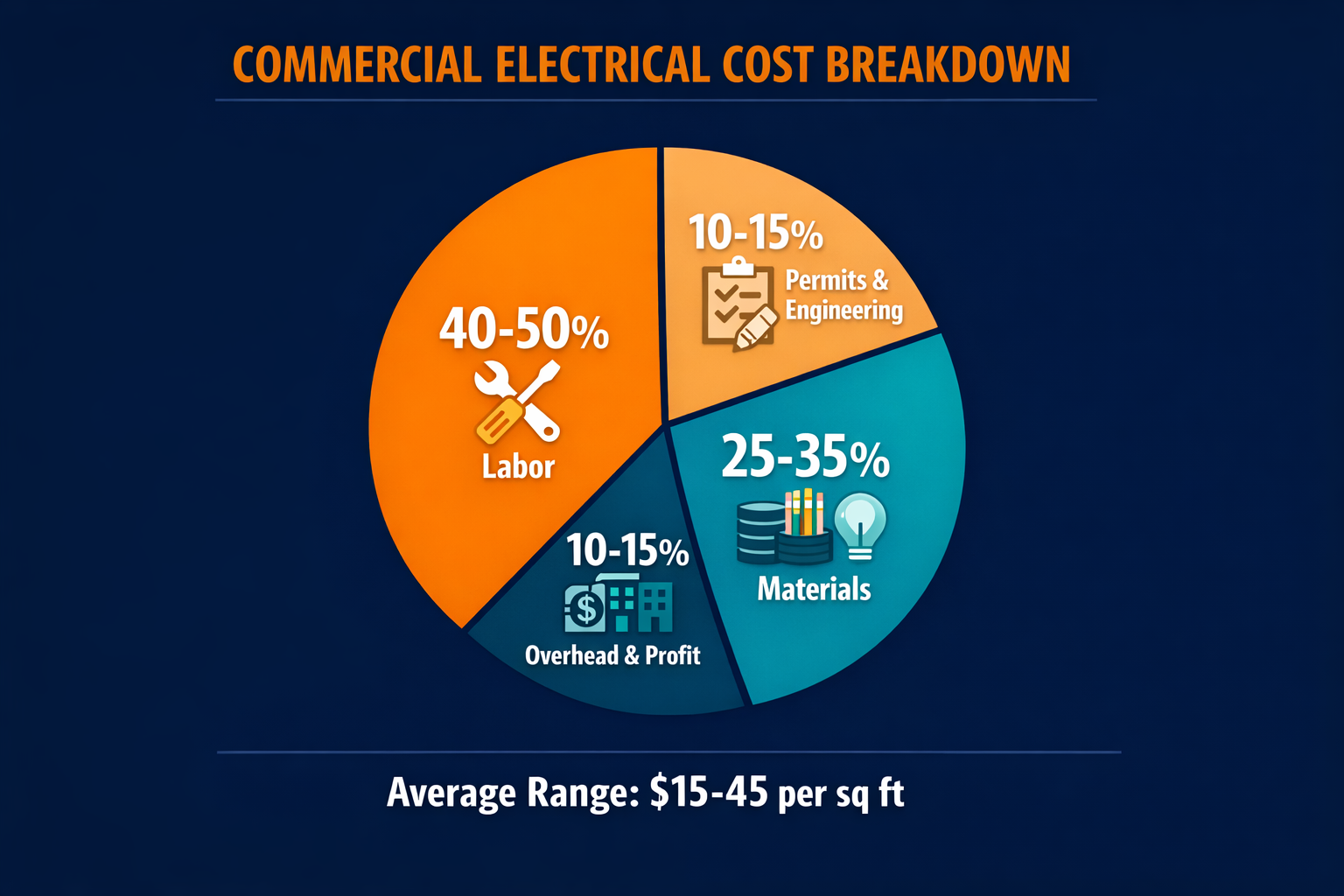
When you're budgeting a commercial electrical project, you need real numbers. But commercial electrical costs vary wildly depending on the project type, building size, complexity, and local market conditions.
This guide breaks down typical commercial electrical project costs in Connecticut so you can budget accurately and avoid nasty surprises.
What Affects Commercial Electrical Costs?
Before we dive into specific projects, here's what drives pricing:
- Materials — wire, cable, conduit, breakers, outlets, fixtures, equipment
- Labor — hourly rates for licensed electricians and apprentices
- Permits and inspections — building department fees
- Complexity — three-phase power, hazardous locations, or specialized systems cost more
- Building access and existing conditions — working in occupied buildings or retrofitting old buildings takes longer
- Timeline — fast-track projects cost more due to overtime and scheduling
- Supply chain — material availability and lead times affect quotes
- Code compliance upgrades — bringing old buildings up to current code adds cost
Get quotes from multiple contractors. Costs vary, and a detailed quote shows exactly what you're paying for.
Panel Upgrades
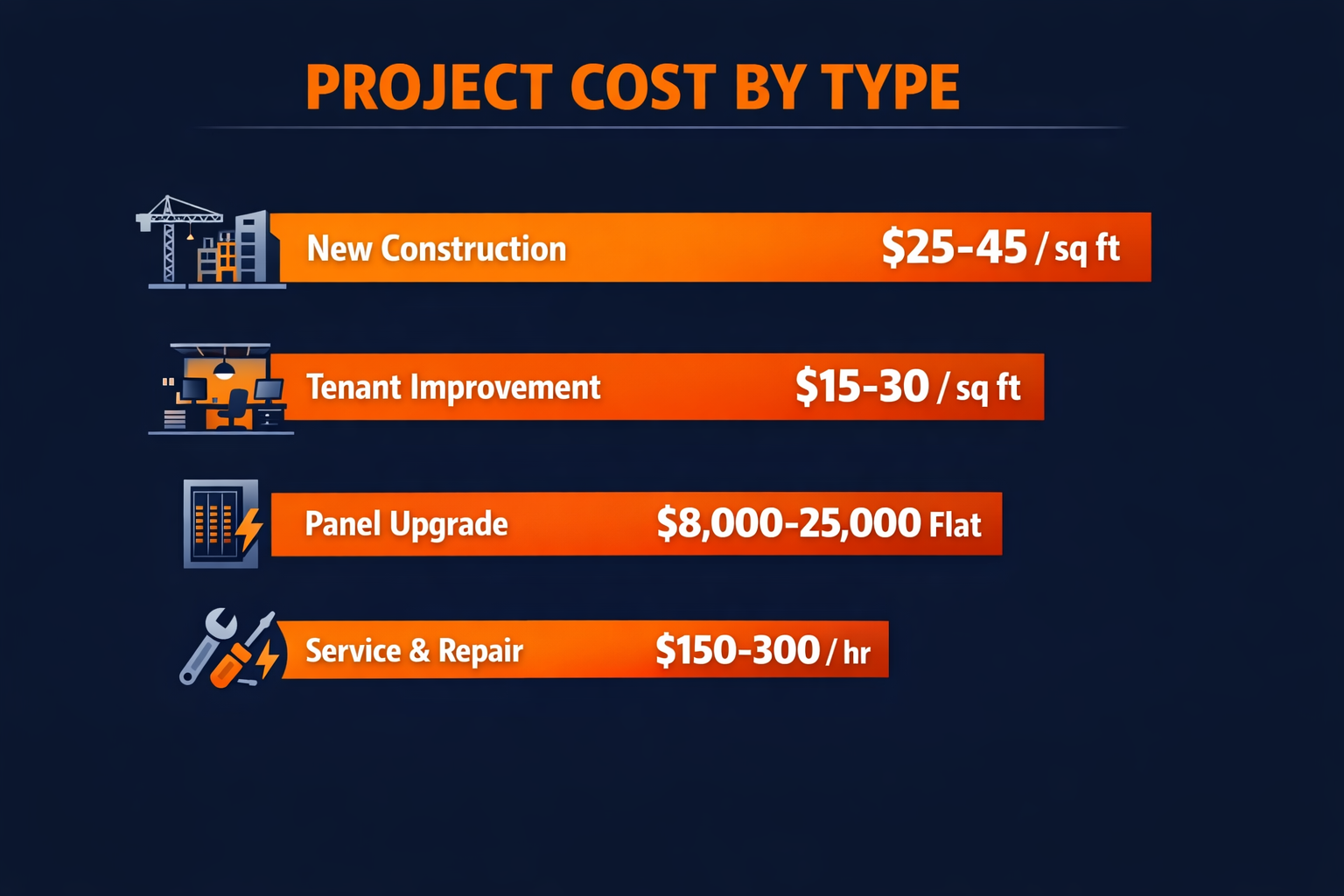
A panel upgrade increases your service capacity. This is common when businesses add equipment, expand HVAC systems, or upgrade lighting.
- 100-amp to 200-amp upgrade (single-phase): $2,500 - $4,500
- 200-amp to 400-amp upgrade (single-phase): $4,500 - $7,500
- Main breaker replacement only (no service upgrade): $800 - $1,500
- Adding circuits to existing panel (per circuit): $150 - $350
- Sub-panel installation (100 amps): $1,500 - $2,500
Cost drivers: Panel location relative to service entrance, wall demolition needed (concrete vs. drywall), existing conduit reuse, and whether the utility company needs to upgrade their infrastructure (can add $1,000-$3,000).
Pro tip: If you're planning expansion, upgrade to higher capacity now. Adding capacity later costs more and disrupts your operation.
Tenant Buildouts and Improvements
Tenant improvement (TI) electrical work varies dramatically by scope. Here are common ranges:
- Small office space (1,000-2,000 sq ft, basic outlets and lighting): $8,000 - $15,000
- Medium office space (2,000-5,000 sq ft, conference rooms, multiple circuits): $15,000 - $30,000
- Large office (5,000-10,000+ sq ft): $30,000 - $60,000+
- Retail space (standard buildout): $12,000 - $25,000
- Warehouse/manufacturing space (minimal power layout): $10,000 - $20,000
- Warehouse/manufacturing (with 3-phase equipment, machinery): $25,000 - $75,000+
These are rough ranges. A startup office in an existing plug-and-play space costs less than a raw shell requiring full electrical infrastructure.
Key cost drivers: Whether the space has existing circuits (reuse is cheaper), power requirements for equipment, fire alarm integration, HVAC power, and code compliance needs.
Lighting Retrofits
Upgrading from old fluorescent or incandescent to LED is popular for energy savings and improved lighting quality.
- Simple LED retrofit (fixtures only, existing wiring): $3,000 - $10,000 for typical office (depending on fixture count)
- LED retrofit with new conduit/wiring: $8,000 - $20,000
- Full lighting system replacement with controls (occupancy sensors, dimming): $15,000 - $35,000
- Outdoor/parking lot lighting upgrade: $5,000 - $15,000 (depending on pole count and distance from service)
Cost per fixture: $150-$400 installed (simple retrofit) to $400-$800 installed (with controls and new wiring).
Savings: LED systems typically reduce energy consumption by 40-60%, which translates to payback in 3-5 years depending on usage.
Fire Alarm System Installation
Fire alarm costs depend on building size and system complexity.
- Small building, basic system (5,000 sq ft): $3,000 - $6,000
- Medium building, addressable system (10,000-15,000 sq ft): $6,000 - $12,000
- Large building or complex system (25,000+ sq ft, multiple zones, voice evac): $12,000 - $30,000+
- Annual monitoring and maintenance: $500 - $1,500/year
What's included: Panel, sensors (smoke/heat detectors), pull stations, sirens/strobes, backup battery, and cabling.
Additional costs: Monthly monitoring service (typically $30-$60), annual testing and certification.
Fire alarm systems are required in most commercial buildings over a certain size. Check your local code — it's not optional.
Security Camera Systems (CCTV)
Security system costs vary by camera count, type, and storage.
- Small system (4-8 cameras, basic NVR): $2,000 - $5,000
- Medium system (8-16 cameras, better quality, cloud backup): $5,000 - $12,000
- Large system (16+ cameras, high-resolution, redundant storage): $12,000 - $30,000+
- Per-camera installation (hardwired, with conduit): $300 - $600
Additional costs: Cabling, conduit runs (especially if running through concrete or existing buildings), monitor displays, server hardware, and cloud storage subscriptions ($20-$100/month).
CCTV systems add security and liability protection. The cost is an investment, not just an expense.
EV Charger Installation
EV charging infrastructure is increasingly important for commercial buildings.
- Level 2 charger installation (240V, single unit): $800 - $2,000
- Level 2 charger (multi-unit with networked management): $1,500 - $3,500 per unit
- DC fast charger installation (50+ kW): $5,000 - $15,000+ (plus significant service upgrades)
- EV-ready infrastructure (conduit, capacity reservation, no charger installed yet): $1,500 - $4,000
Major cost driver: If your service doesn't have capacity for chargers, you'll need a panel upgrade or service upgrade, adding $2,000-$7,000.
Incentive tip: Federal tax credits and state incentives can offset 30-50% of EV charger installation costs. Check with your state and utility provider.
Service Entrance and Meter Upgrades
Service entrance work includes the main breaker, meter, and connections to utility infrastructure.
- Meter replacement only (existing service, same capacity): $500 - $1,000
- Service entrance upgrade (new meter, main breaker, same capacity): $1,500 - $3,000
- Full service upgrade with increased capacity: $3,000 - $8,000+
- Utility company charges (service extension, infrastructure upgrade): $500 - $3,000+
Important: The utility company may charge for service upgrades on their side (running larger lines, installing new infrastructure). These costs are separate from the electrician's labor and can be substantial.
Generator Installation
Backup power generators protect against outages and are increasingly important for data centers, medical facilities, and businesses where downtime = lost revenue.
- Small portable generator (5-10 kW): $500 - $2,000 (equipment only)
- Permanently installed standby generator (15-30 kW, residential-to-small commercial): $3,000 - $8,000
- Commercial standby generator (50 kW): $8,000 - $15,000
- Large commercial generator (100+ kW with auto-transfer switch): $15,000 - $50,000+
- Installation and integration (electrical work): $1,500 - $5,000+
Additional costs: Fuel tank installation, automated transfer switch (ATS), wiring/conduit, permits, testing.
Generator selection depends on your critical loads. A data center needs full-facility backup. A small office might only back up critical areas (servers, lighting, HVAC).
Rewiring and Hazardous Location Work
Specialized wiring for specific environments costs more.
- Complete building rewire (per 1,000 sq ft): $2,000 - $4,000
- Hazardous location wiring (Class I, Division 1 environments): 20-40% premium over standard work
- Underground conduit runs (per linear foot): $15 - $30
Hazardous locations (flammable atmospheres, explosive atmospheres) require special cables, fittings, and installation techniques. Never cut corners here — codes are strict, and safety is critical.
Cost-Saving Tips
Plan ahead. Bundling projects is cheaper. Upgrading service and installing circuits at the same time saves money vs. doing them separately.
Work within existing infrastructure. Reusing existing conduit, panels, and wiring saves material costs. Full rewiring costs significantly more than upgrades.
Standardize equipment. Buying all the same breaker brand, outlet type, or fixture model reduces supplier costs and labor time.
Get permits early. Unpermitted work that must be redone costs way more than the permit fee ever would.
Build in capacity for growth. Oversizing service now (200 amps instead of 100, deeper panel, more circuits) costs marginally more upfront but saves thousands in future upgrades.
Get competitive quotes. Material prices are relatively fixed, but labor rates vary. Get at least two detailed quotes so you know what you're paying for.
What's Included in a Professional Quote?
A detailed quote should specify:
- Materials (with brands/specs)
- Labor (hours and rates)
- Permits and inspection fees
- Utility connection fees (if applicable)
- Timeline and completion date
- Warranty terms
- Payment schedule
If a quote is vague ("around $15,000"), ask for itemization. You should know exactly what you're paying for.
Why Hire a Licensed Commercial Electrician?
Cheap quote from an unlicensed contractor? Pass. Licensed, insured contractors cost more because they:
- Follow code and pull permits
- Carry liability insurance (protects you if something goes wrong)
- Guarantee workmanship
- Know how to avoid expensive mistakes
A professional electrician's quote might be 20-30% higher than an unlicensed contractor, but your building is safer, code-compliant, and properly documented.
Electrical work is infrastructure. Cutting corners on cost means cutting corners on safety. The cheapest option often becomes the most expensive when it fails.
Your Next Step
For a commercial electrical project in Connecticut, get a professional quote from a licensed contractor who understands your specific needs. We do panel upgrades, service improvements, lighting retrofits, fire alarms, security systems, and everything else. Call 203-389-5112 for a detailed estimate.
Get a Detailed Commercial Electrical Quote
Licensed contractors. Itemized pricing. No surprises.
Call 203-389-5112