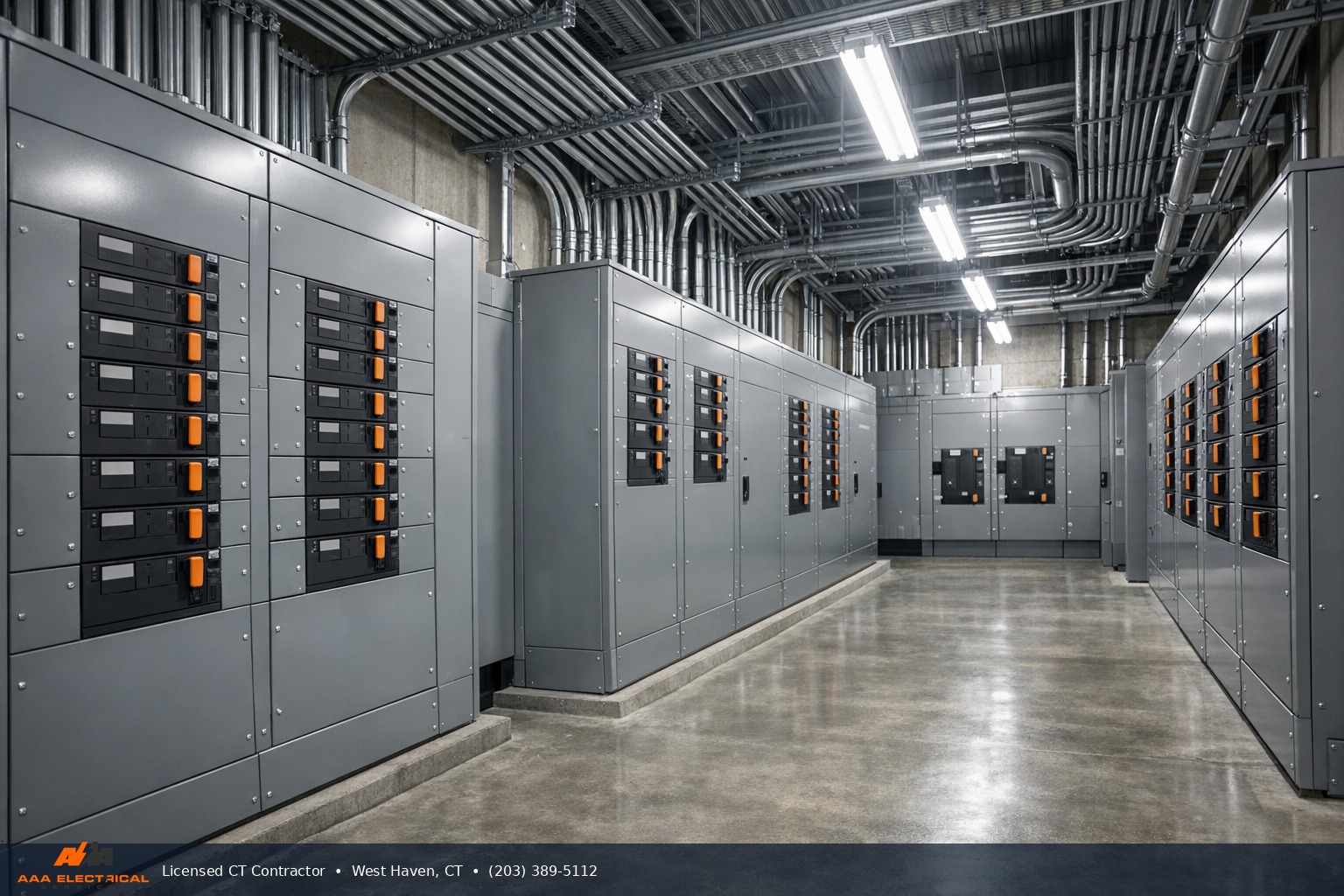
Connecticut commercial buildings must comply with the National Electrical Code (NEC) as adopted by the state, plus local amendments. If you're planning a renovation, lease improvement, equipment upgrade, or new build, you need to understand what codes apply, what permits are required, and what violations cost.
This guide covers the key 2023-2026 commercial electrical code requirements that affect Connecticut businesses, with specific focus on practical compliance issues.
The NEC 2023 Standard in Connecticut
Connecticut adopted the National Electrical Code 2023 as its statewide standard. The NEC is published every three years by the National Fire Protection Association (NFPA). It's the baseline electrical safety code for the entire United States.
Important: Connecticut allows individual municipalities to amend the NEC with stricter local requirements. So if you're doing work in Bridgeport, New Haven, or Stamford, your local building department may have adopted additional rules beyond the state NEC 2023.
Always check with your local building department before starting commercial electrical work. Their adopted code is the law you must follow.
What Requires a Permit?
Nearly all commercial electrical work in Connecticut requires a building permit and electrical inspection. This includes:
- New buildings or additions
- Tenant improvements — modifying space for a new tenant or use
- Panel upgrades or service changes
- Branch circuit additions — new circuits, outlets, or switches
- Equipment installation — HVAC, motors, generators, fire alarms
- EV charger installation
- Solar systems
- Lighting upgrades (structural/permanent installations)
- Security systems (hardwired installations)
- CCTV and video systems (permanent installations)
Repairs and maintenance typically don't need permits if they're replacing existing equipment with equivalent. But if you're upgrading capacity, changing voltages, or modifying circuits, that's a permitted project.
Never skip the permit. Unpermitted work voids warranties, fails final inspections, and exposes you to insurance liability. If there's a fire and the work wasn't permitted, your insurance may deny the claim.
Key NEC 2023 Updates Affecting Commercial Properties
Arc-Fault Circuit Interrupters (AFCI)
The 2023 NEC significantly expanded AFCI requirements. Most branch circuits in commercial buildings now require arc-fault protection. AFCIs detect dangerous partial breaks in wiring (arcs) that can cause fires.
In older buildings being renovated, you may need to upgrade panels and breakers to accommodate AFCI protection. This is a common compliance cost.
Ground-Fault Circuit Interrupters (GFCI)
All wet areas (bathrooms, kitchens, mechanical rooms, outdoor) require GFCI protection. The 2023 update expanded this to additional areas and appliances. All receptacles in these areas must be either GFCI outlets or protected by a GFCI breaker.
Failure to provide GFCI protection is a code violation and a serious shock/electrocution hazard.
Equipment Grounding and Bonding
Updated rules on grounding equipment and bonding non-current-carrying components. This affects panel installations, equipment racks, and structural steel connections. Many older buildings lack proper bonding, which must be corrected in renovation.
Capacity and Demand Calculations
The 2023 NEC clarifies demand factor calculations for commercial loads. If you're planning expansion or renovation, your electrician must perform load calculations to ensure your service is adequate. Undersized service is a common code violation.
EV Charging Infrastructure (New Section 625)
The 2023 NEC includes a dedicated section on EV charging. Any commercial building with parking must now consider EV charger readiness. Even if you're not installing chargers now, the code expects infrastructure prep (conduit, panels, capacity) for future installation.
If you're renovating parking areas or upgrading service, account for EV charging requirements in your electrical design.
Fire Alarm Systems and Life Safety Code
Most commercial buildings must have fire alarm systems. Connecticut follows NFPA 72 (National Fire Alarm Code) and the Life Safety Code.
Requirements vary by:
- Building size (over 5,000 sq ft typically requires alarms)
- Occupancy type (high-risk uses like medical, industrial, kitchens have stricter requirements)
- Building height (high-rise buildings have more stringent requirements)
- Specific uses (storage of hazardous materials, high-density occupancy)
Fire alarm systems must be installed, tested, and maintained by licensed contractors. They require proper backup power (battery backup), monitoring, and regular inspection.
When planning renovations, coordinate with your fire alarm contractor to ensure the system can be extended and tested. Many code violations occur when fire alarm systems aren't properly extended during tenant improvements.
Common Code Violations in Connecticut Commercial Buildings
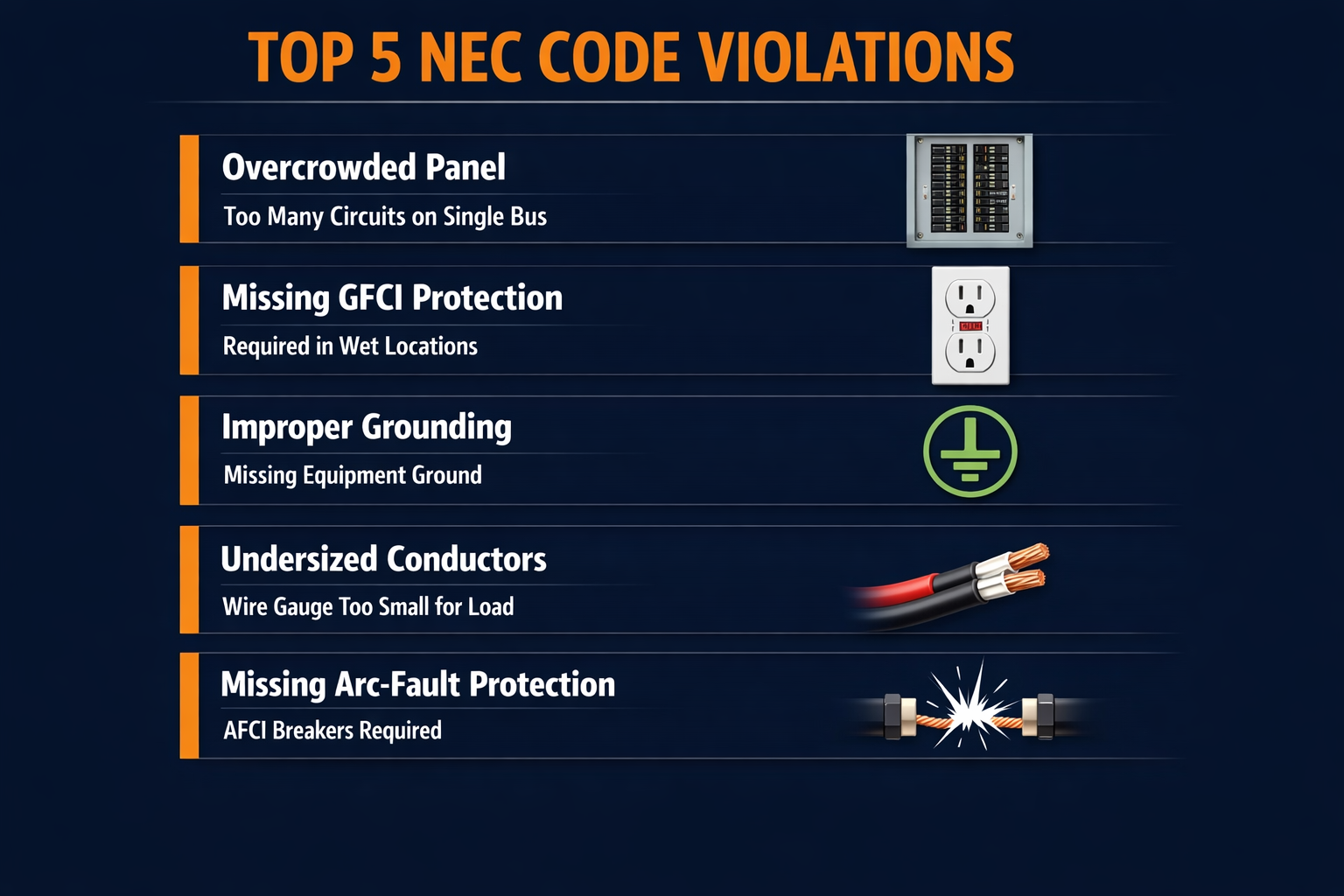
Overloaded Circuits
Plugging too many devices into one circuit. The code limits load based on wire gauge and breaker size. When circuits are overloaded, breakers trip or connections overheat.
Undersized Service for Current Load
Adding equipment (HVAC, server racks, kitchen equipment) without upgrading service capacity. The service must be sized for peak demand plus growth capacity. Undersized service causes voltage sag, equipment damage, and fire risk.
Missing or Inadequate Grounding
Older buildings often lack proper grounding. Grounding protects people and equipment from shock and surges. This is a safety issue and a code violation.
Improper GFCI/AFCI Protection
Missing or incorrect outlet types in wet areas. Every bathroom, kitchen, and mechanical space needs GFCI. Missing GFCI is a code violation and electrocution hazard.
Inadequate Labeling
Breaker panels must have clear, readable labels identifying each circuit. Faded or missing labels make it impossible to identify circuits during emergencies or maintenance.
Improper Conduit or Cable Runs
Wiring run through inappropriate spaces (exposed in occupied areas, unprotected in wet spaces, unsupported), or undersized conduit for wire gauge. Improper runs expose wiring to damage and fire risk.
Insufficient Receptacle Placement
The code specifies maximum distances between receptacles in different room types. Commercial spaces need adequate receptacle density to prevent overloading single circuits.
Permit and Inspection Process in Connecticut
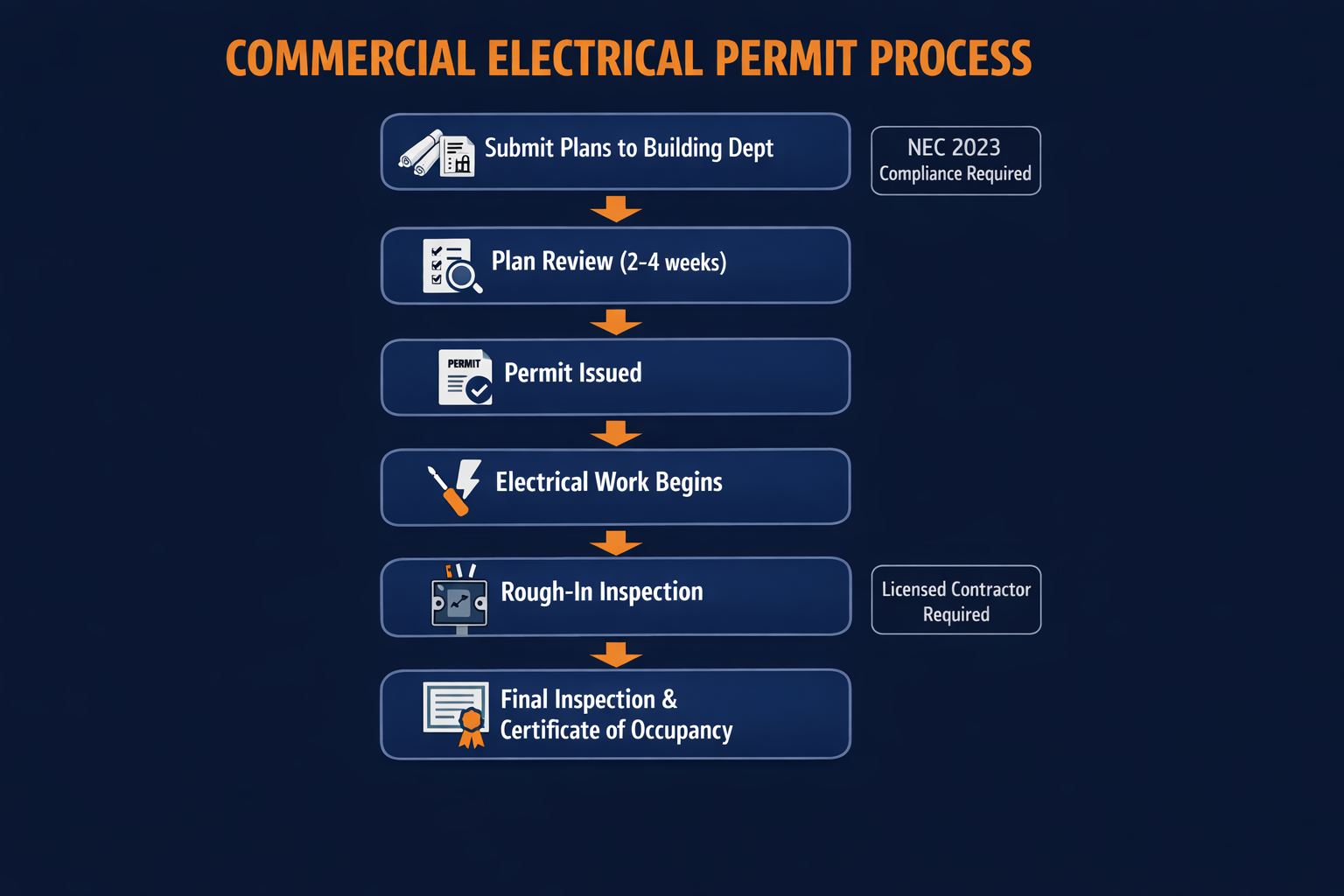
Here's how commercial electrical permits work in Connecticut:
- Licensed contractor submits permit application to local building department with plans and specs
- Building department reviews for code compliance and approves (or requests revisions)
- Permit is issued — fee based on project scope/cost
- Work is performed by licensed electrician(s)
- Rough-in inspection — inspector verifies wiring before walls are closed
- Final inspection — inspector tests all circuits, grounds, and safety devices
- Certificate of compliance issued once work passes inspection
Plan 2-3 weeks for permit approval and inspections. Some municipalities are slower. Coordinate inspection scheduling with your contractor — failed inspections delay your project and increase costs.
Special Requirements for Specific Uses
Commercial Kitchens
Kitchens require GFCI protection on all countertop receptacles, separate circuits for major equipment, appropriate wire gauges for high-amperage equipment (ovens, fryers), and proper grounding for gas equipment.
Data Centers and Server Rooms
Require dedicated, stable power distribution, surge protection, battery backup systems (UPS), redundant circuits, and proper grounding to prevent equipment damage and data loss.
Medical Facilities
Follow stricter codes including dedicated circuits for critical equipment, backup power requirements, surge protection, and regular testing and maintenance.
Manufacturing and Industrial
Three-phase power distribution, motor circuits with proper overload protection, hazardous location wiring (if applicable), emergency shutoff systems, and equipment lockout/tagout compliance.
Outdoor and Wet Locations
All outdoor receptacles and lighting require GFCI protection and weatherproof covers. Wiring must be rated for wet environments (typically UV-resistant cable or conduit).
EV Charger Readiness (New Priority)
Connecticut is increasingly focused on EV readiness. While not all buildings must install chargers, new or heavily renovated buildings should plan for EV infrastructure.
This means:
- Conduit runs from main panel to parking areas
- Panel capacity reserved for future chargers
- Parking spaces with accessible circuit headers for charger connections
Planning for EV charger installation now saves thousands in retrofit costs later. Most new commercial projects should include EV-ready infrastructure.
Hiring a Licensed Commercial Electrician
To ensure compliance, hire a licensed CT electrical contractor with commercial experience. Verify:
- Current CT license (E-1 or E-2 journeyperson for commercial work)
- Current insurance coverage
- Experience with commercial code compliance
- Reference from similar commercial projects
- Willingness to pull permits and coordinate inspections
A contractor who skips permits is cutting corners. The savings are illusory — unpermitted work costs far more when it fails inspection or causes problems.
Your Path to Compliance
If you're planning commercial electrical work in Connecticut:
- Consult your local building department about specific code requirements for your municipality
- Get a design plan from a licensed commercial electrician (load calculations, grounding, circuit layout)
- Pull a permit before starting work
- Schedule inspections at rough-in and final stages
- Address any violations before final approval
- Document everything — permits, inspections, certificates of compliance
This process takes time but ensures your building is safe, code-compliant, and properly documented for insurance and future sales.
Electrical code compliance isn't optional — it's how buildings stay safe and insurable. Skipping it costs far more than the permit and inspection fees.
Need Help with Commercial Code Compliance?
AAA Electrical Services handles commercial electrical work across Connecticut with full code compliance. We pull permits, coordinate inspections, and ensure your project meets NEC 2023 and local requirements. Call 203-389-5112 for a free estimate and code review.
Get Your Commercial Electrical Project Code-Compliant
We handle permits, inspections, and full NEC 2023 compliance for CT commercial buildings.
Call 203-389-5112